
Construction project
NEWS
15. September 2026
Veranstaltungen im Begegnungszentrum
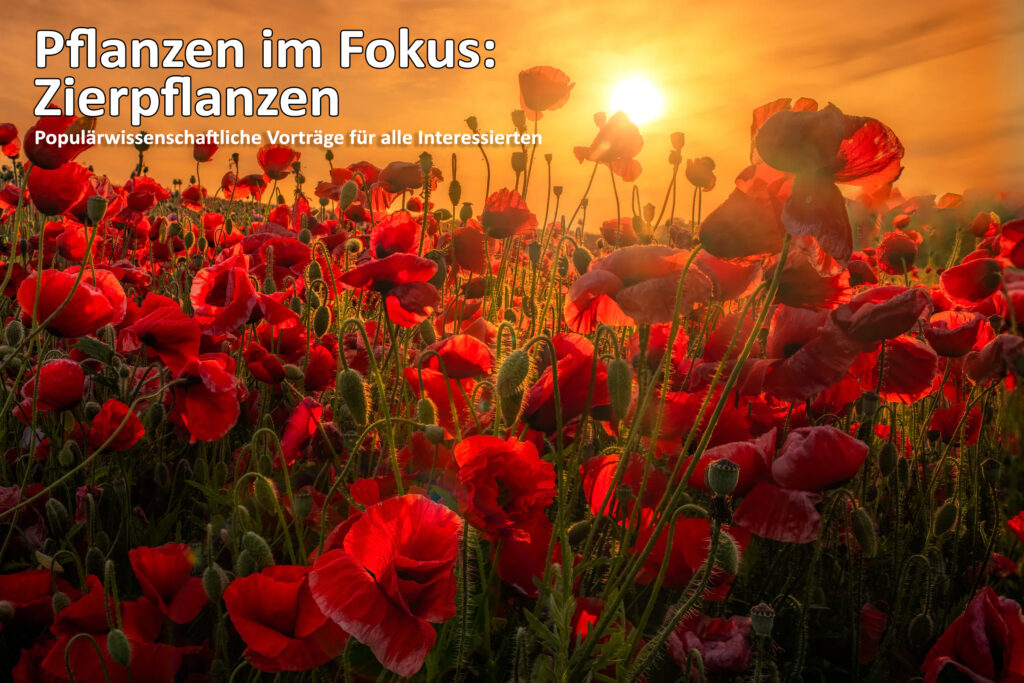
Warum faszinieren uns Zierpflanzen? Was steckt hinter ihrer Vielfalt, ihren Farben und Formen – und welche Geschichten, wissenschaftlichen Erkenntnisse und Zusammenhänge verbergen sich hinter Pflanzen, die uns im Alltag, in Gärten und Wohnungen begegnen?
The XLAB Stiftung lädt in der Adventszeit im November und Dezember zu einer neuen populär-wissenschaftlichen Vortragsreihe ein. An drei Abenden stehen Zierpflanzen im Mittelpunkt.
Die Vorträge richten sich ausdrücklich an alle Interessierten – wissenschaftliche Vorkenntnisse sind nicht erforderlich. Besonders freuen wir uns auch über Gäste aus Weende und der näheren Umgebung, die das XLAB und die XLAB Stiftung bei dieser Gelegenheit kennenlernen möchten.
Termine:
Samstag, 28. November 2026, 17:00 Uhr
Samstag, 5. Dezember 2026, 17:00 Uhr
Samstag, 12. Dezember 2026, 17:00 Uhr
Ort:
XLAB Stiftung
Begegnungszentrum
Stumpfe Eiche 20
37077 Göttingen-Weende
Begleitend zur Vortragsreihe ist auch ein Verkauf von Zierpflanzen vorgesehen.
Im März 2027 wird die Reihe fortgesetzt. Dann dreht sich alles um Nutzpflanzen.
Weitere Informationen zu den einzelnen Vorträgen folgen.
7. September 2026
In Memory of Ada Yonath
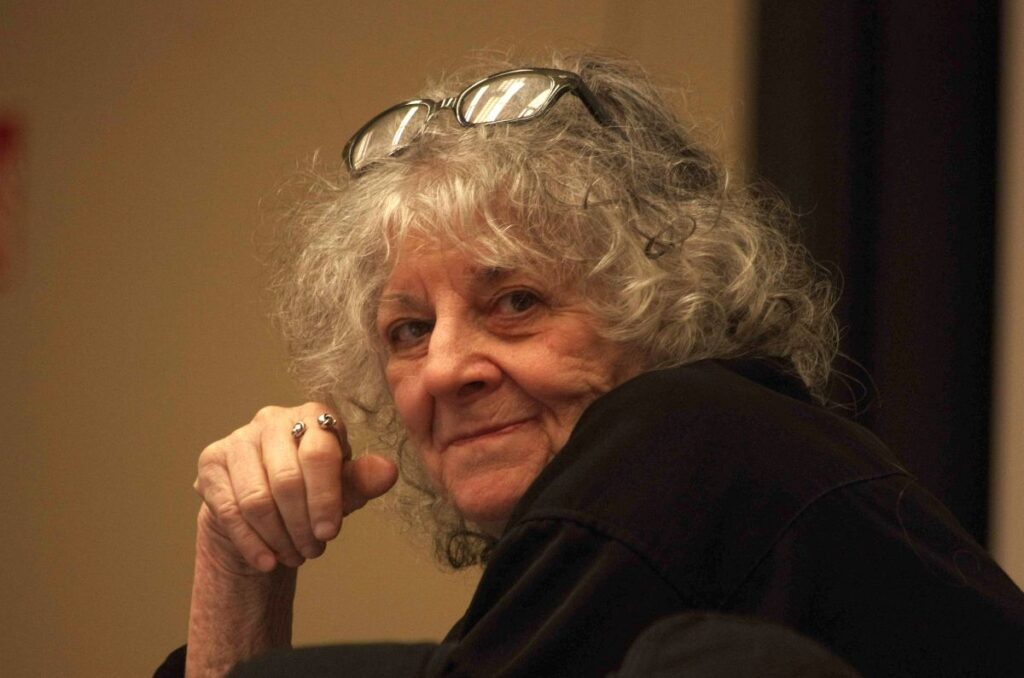
It is with great sadness that we have learned of the passing of Israeli structural biologist and Nobel laureate Prof. Ada E. Yonath. She died on August 31, 2026, at the age of 87.
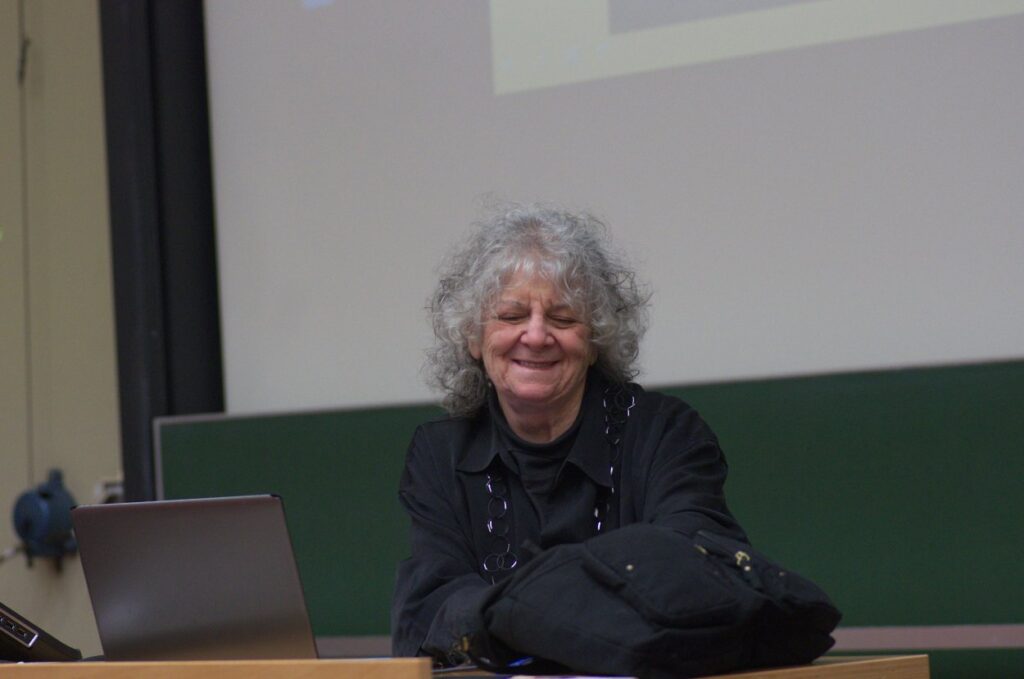
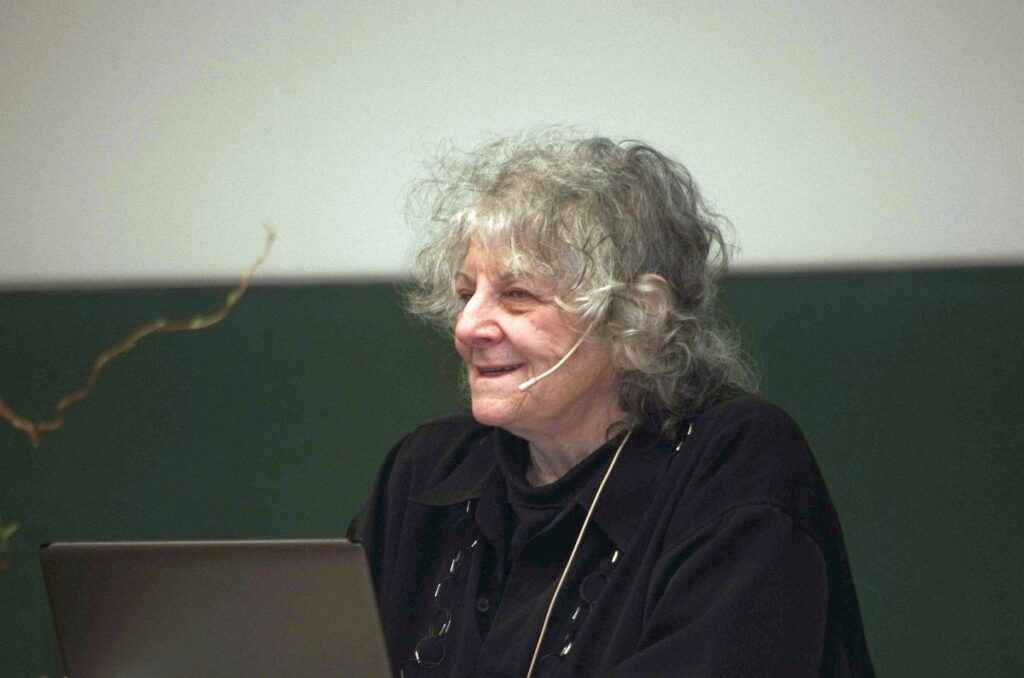
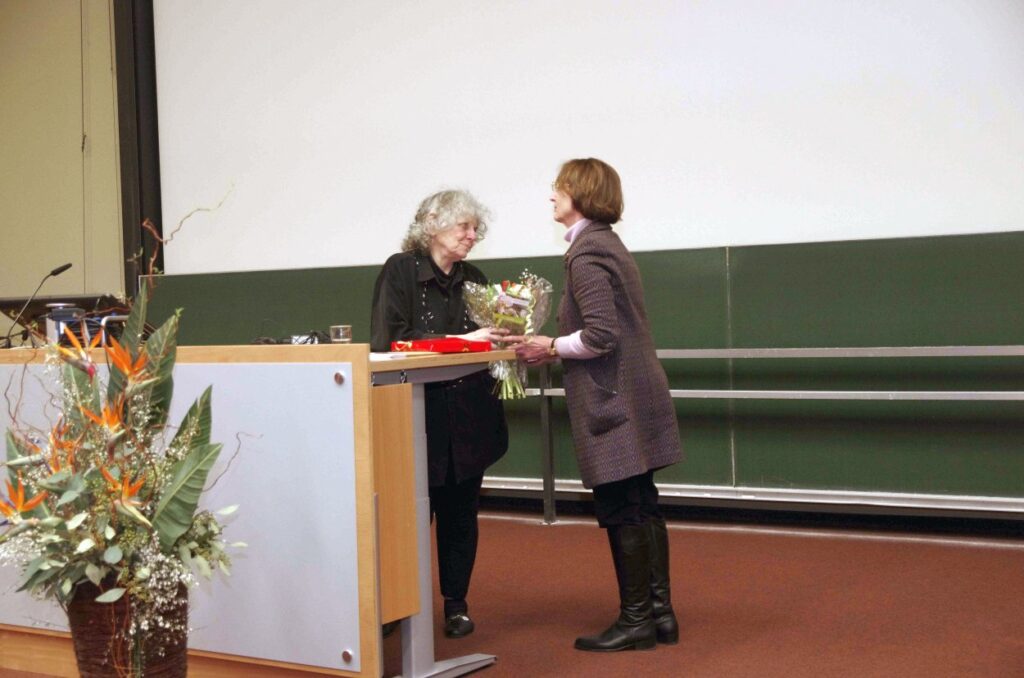
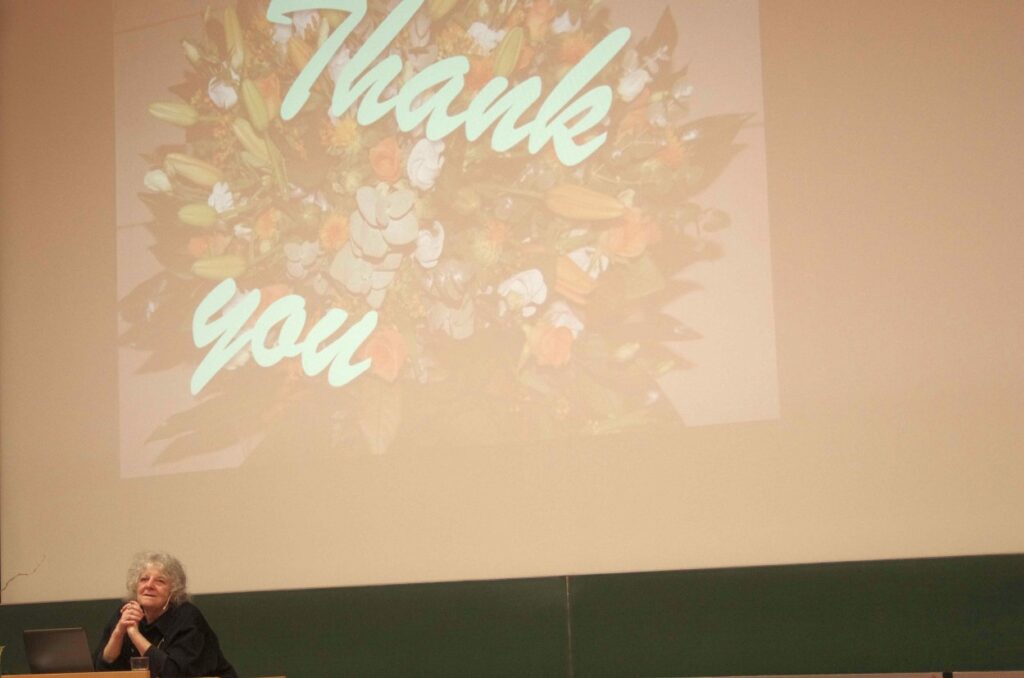
Ada Yonath was one of the most outstanding scientists of our time. In 2009, she was awarded the Nobel Prize in Chemistry, jointly with Venkatraman Ramakrishnan and Thomas A. Steitz, for her groundbreaking work on the structure and function of ribosomes. In January 2015, Ada Yonath was a guest at the XLAB Science Festival in Göttingen. In her lecture, “Climbing the Everest beyond the Everest: Resistance to Antibiotics and Origin of Life,” she discussed her research on ribosomes and the development of antibiotic resistance. Above all, she conveyed the curiosity and perseverance that had shaped her scientific career.
The end of her talk was particularly memorable. Ada Yonath addressed the female students in the audience personally and encouraged them to forge their own paths in science. She made it clear that women can be outstanding scientists, and that scientific success need not conflict with a fulfilling family life. The report in the *Göttinger Tageblatt* at the time explicitly highlights this moment. And then Ada Yonath showed a very special award: a prize designed by her granddaughter with the inscription “The grama of the year is Ada Yonath!”—the award for “Best Grandma of the Year.” This prize, she explained, is something she has to earn over and over again. It means more to her than the Nobel Prize.
It is precisely this little story that has stayed in the memories of many who had the chance to meet Ada Yonath at XLAB back then. It revealed the person behind the famous scientist—someone for whom a passion for science and family naturally went hand in hand. Eva-Maria Neher, who had invited Ada Yonath to the Science Festival in Göttingen and had the opportunity to meet her again in the summer of 2026 at the Nobel Laureate Meeting in Lindau, particularly remembers this personal closing remark from her 2015 lecture.
We are grateful to have had the opportunity to meet Ada Yonath at the XLAB Science Festival in 2015, and we will remember her as an extraordinary scientist and an impressive person.

April 16, 2026
XLAB Foundation Opens New Community Center in Göttingen-Weende
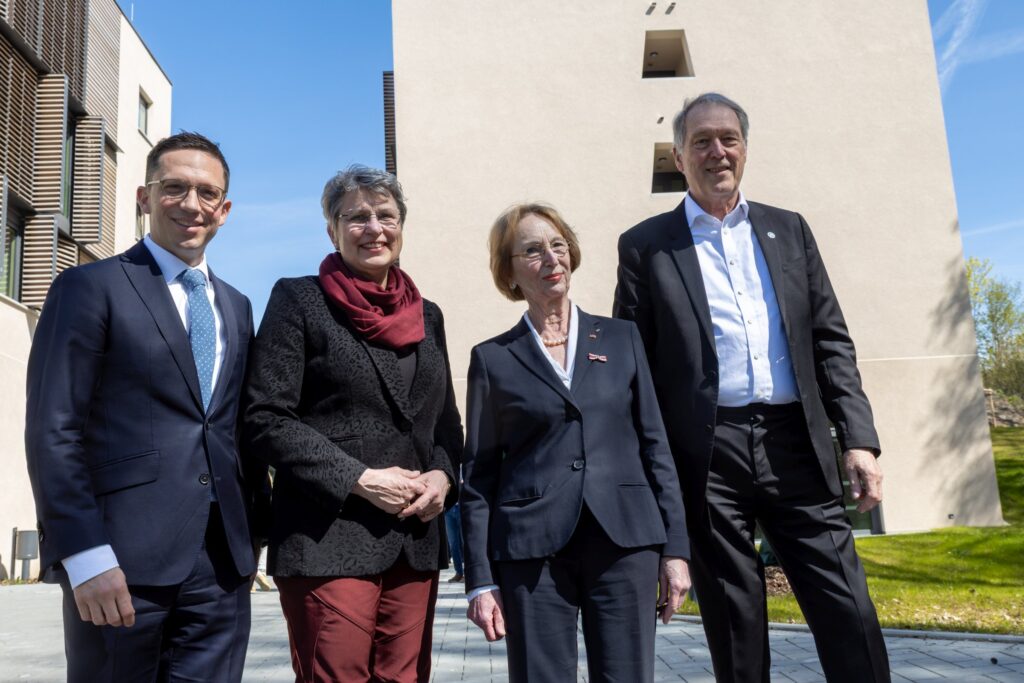
The XLAB Foundation officially opened its new meeting center with residential wing in Göttingen-Weende with a ceremony on April 15, 2026. The new building expands the XLAB Experimental Laboratory with seminar rooms, accommodation, and communal areas, thereby creating new opportunities for multi-day courses, science camps, university seminars, and other educational programs.
The new building will create a space where education, social interaction, and scientific exchange come together in a unique way. In addition to seminar rooms, the building features living quarters, common areas, a dining room, and a large catering kitchen. This will make it possible to host multi-day events directly connected to XLAB in the future.
The completion of the community center marks the successful conclusion of a long planning and construction process. For many years, there had been a desire to expand the XLAB Experimental Laboratory to include spaces that would facilitate not only scientific work but also communal living and learning in a single location. Until now, there had been a lack of suitable accommodation and communal spaces, particularly for programs lasting several days.
At the opening ceremony, the XLAB Foundation welcomed numerous guests from the academic, political, and civic communities. Opening remarks were delivered by Falko Mohrs, Lower Saxony’s Minister of Science and Culture; Prof. Dr. Axel Schölmerich, President of the Georg-August University of Göttingen; and Petra Broistedt, Mayor of the City of Göttingen. In their remarks, they emphasized the importance of XLAB and the new meeting center for the educational and scientific landscape. It became clear that the facility serves as a hub for fostering young talent, scientific exchange, and collaboration far beyond Göttingen. Translated with DeepL.com (free version)
Another highlight of the event was the presentation by Prof. Dr. Eva-Maria Neher, Chair of the XLAB Foundation. In her talk, she described the long and often difficult history of the construction project, which was marked by challenges, design changes, and financing issues over many years. This made the joy all the greater that the community center has now been successfully completed and opened.
With the new building, a long-held goal is becoming a reality: a place where young people from different regions and countries can not only learn together, but also engage in conversation, spend time together, and experience science as a vibrant, unifying experience.
XLAB is one of Germany’s largest student laboratories for STEM subjects —physics, chemistry, biology, mathematics, and computer science. As a multi-award-winning extracurricular learning center, it offers students hands-on experimental courses, in-depth programs for particularly interested young people, and professional development for teachers. The new community center will significantly expand these opportunities.
The new building is primarily intended for XLAB students, but is also available for seminars, workshops, and retreats organized by researchers from the research institutes on the science campus. It thus provides the physical space needed to bring learning, socializing, and collaboration even closer together.
For Göttingen as a hub of education and science, the meeting center sends an important signal. The combination of an experimental laboratory, seminar rooms, and lodging opens up new possibilities for innovative event formats and reinforces Göttingen’s reputation as a center of scientific excellence and effective support for young researchers.
March 24, 2026
The XLAB Foundation is opening its new community center with residential quarters
A new venue for education, socializing, and scientific exchange in Göttingen
On April 15, 2026, the XLAB Foundation will officially open its new community center with residential quarters in Göttingen-Weende. The new building expands the XLAB Experimental Laboratory with seminar rooms, living spaces, and common areas, thereby creating new opportunities for multi-day courses, science camps, university seminars, and other educational programs.
The new building will create a space where science education, exchange, and collaborative learning are closely intertwined. In addition to seminar rooms, the building includes living quarters, common areas, a dining room, and a large catering kitchen. This will, for the first time, provide the ideal conditions for hosting multi-day programs in direct connection with the XLAB.
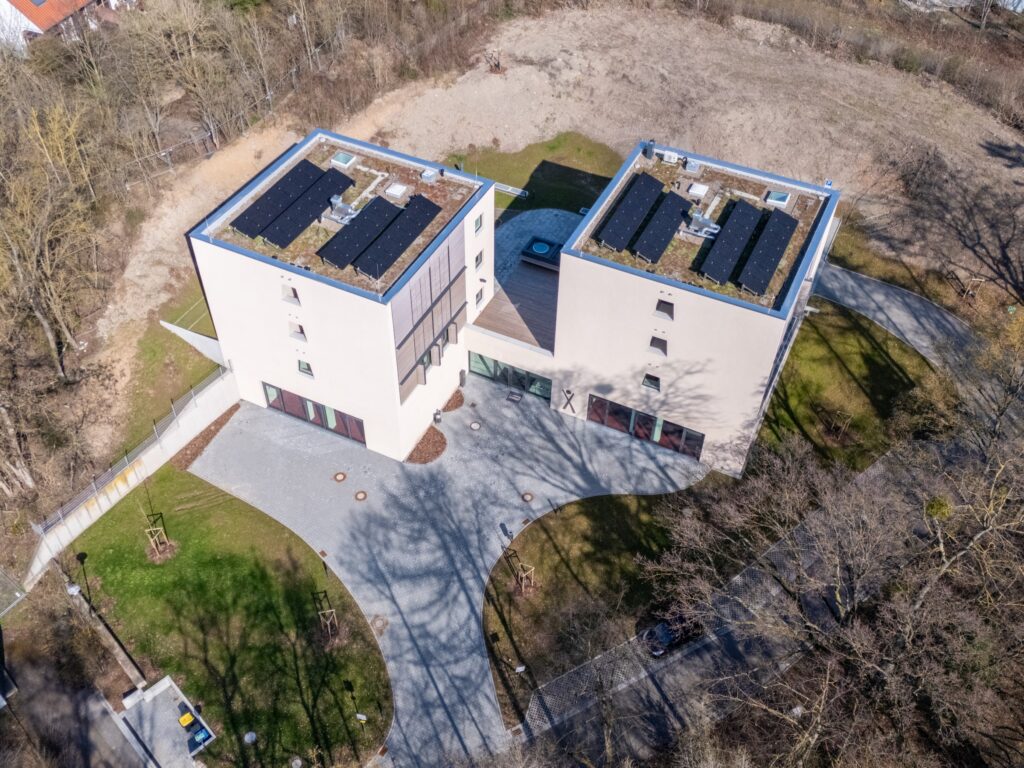
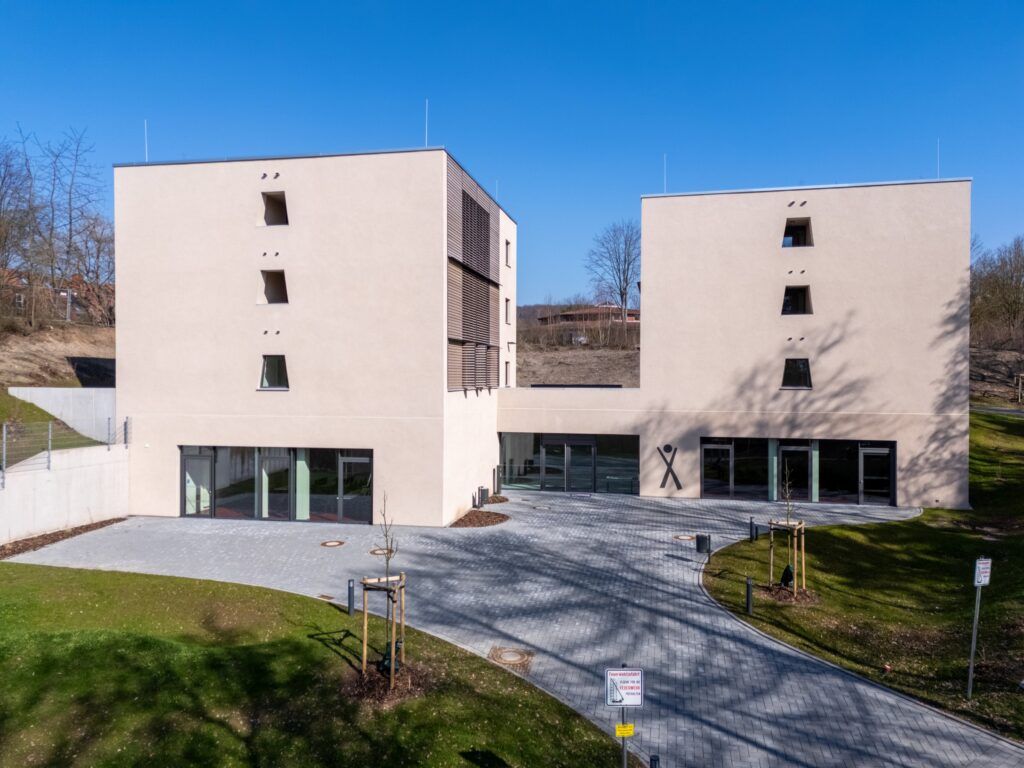
The completion of the community center marks the successful conclusion of a long planning and construction process that began as far back as 2006. It became clear early on that the XLAB Experimental Laboratory was reaching its limits due to high demand and its national and international reach. Until now, there has been a lack of suitable accommodation and meeting spaces, particularly for programs lasting several days.
The new community center marks the realization of a long-held goal: a place where young people from different regions and countries can not only learn together, but also engage in conversation, spend time together, and experience science as a vibrant, unifying experience.
XLAB is one of Germany’s largest student laboratories for STEM subjects —physics, chemistry, biology, mathematics, and computer science. As a multi-award-winning extracurricular learning center, it offers student groups hands-on experimental courses, in-depth programs for particularly interested young people, and professional development for teachers. The XLAB combines research-oriented experimentation with cutting-edge science, thereby providing direct access to scientific questions for many years.
The new community center will significantly expand these opportunities. While the center is primarily intended for XLAB students, it is also available for seminars, workshops, and retreats organized by researchers from the scientific research institutes on the science campus. It provides the physical space needed to bring learning, socializing, and intellectual exchange even closer together.
The new building also sends an important signal for Göttingen as a center of education and science. The combination of experimental laboratories, seminar rooms, and overnight accommodations opens up new possibilities for innovative event formats and reinforces Göttingen’s reputation as a hub of scientific excellence and effective support for young researchers.
The implementation of this construction project presented significant challenges over many years. Financing issues and the need for redesigns repeatedly necessitated adjustments. This makes the joy of seeing the project successfully completed all the greater. The project was significantly shaped and driven forward with great perseverance by Prof. Dr. Eva-Maria Neher, founder and chair of the XLAB Foundation.
“With the Community Center, a long-held dream is becoming a reality. Here, we are creating a place where young people can experience science not only in the lab, but also through interaction with one another and with researchers. For us, education, community, and collaborative thinking are inextricably linked.”
Prof. Dr. Eva-Maria Neher, Chair of the XLAB Foundation
Opening Ceremony on April 15, 2026
Numerous guests from the academic, political, and civic communities are expected to attend the official opening on Wednesday, April 15, 2026, at 2:30 p.m.. Opening remarks will be delivered by Falko Mohrs, Lower Saxony’s Minister of Science and Culture, Prof. Dr. Axel Schölmerich, President of the University of Göttingen, and Petra Broistedt, Mayor of the City of Göttingen.
Following this, Prof. Dr. Eva-Maria Neher will give a lecture titled “From the XLAB Experimental Laboratory to the XLAB Meeting Center”. A reception and a tour of the new building are scheduled to follow.
Event location
XLAB Begegnungszentrum mit Wohntrakt
Stumpfe Eiche 20
37077 Göttingen-Weende
Press Contact
XLAB Stiftung
Prof. Dr. Eva-Maria Neher
E-Mail: eneher1@gwdg.de
Telefon: +49 (0) 551 79 77 47 – 16
Bildmaterial
Pressefotos stehen hier zur Verfügung.
January 29, 2026
Highlights from the 2026 Science Festival
At the event, the presentations spanned a wide range of topics, from “nanometers” to “society”: from novel light microscopes that break through the classical resolution limit, to the rapid evolution of RNA viruses and the data-driven tracking of variants, to the cosmic formation of heavy elements, and finally to the question of how the European dream has changed historically and what threatens it today. The humanities lecture took place in the auditorium building of Georg-August University of Göttingen, while the natural sciences presentations were held in the new meeting center of the XLAB Foundation.
Prof. Dr. Eva-Maria Neher, chair of the XLAB Foundation and organizer of the XLAB Science Festival, introduced the speakers at the newly opened community center and noted that all of the speakers had previously contributed to the festival in past years. This was in commemoration of the first XLAB Science Festival, which took place in 2005 to celebrate the completion of the XLAB student laboratory building. Prof. Dr. Erwin Neher (1991 Nobel Prize in Medicine) was present as patron of the Science Festival series.

Presentations
on January 28 and 29, 2026
Prof. Dr. Stefan Hell
“How to overcome a supposed scientific barrier… and what can be done with it”

Prof. Dr. Stefan Hell (2014 Nobel Prize in Chemistry) took the audience on a journey that led him to the question of how to tackle an “insurmountable” limit—and why it is worth holding on to such an idea. The starting point was the diffraction limit formulated by Ernst Abbe: A resolution better than about 200 nm seemed impossible for a long time with focused light in the classical light microscope. Hell demonstrated how this limit can be practically circumvented using super-resolution techniques—most notably STED—and how subsequent developments are continually improving the localization of individual fluorophores. Newer approaches such as MINFLUX/MINSTED achieve resolutions in the range of a few nanometers, reaching scales that are already approaching the dimensions of individual fluorescent molecules.
Prof. Dr. Richard Neher
Coronavirus, the flu, HIV … Why are RNA viruses so adaptable?

Prof. Dr. Richard Neher explained why RNA viruses (e.g., influenza, RSV, or HIV viruses) are so “adaptable”: Due to their high mutation rate, their surface structures in particular are constantly changing. This makes it easier for the viruses to evade the immune system and repeatedly infect humans. A key focus was on how the spread of variants can be tracked in near real time using numerous genome sequences and modern analysis methods—including well-founded predictions about which lineages are likely to prevail and how this information can inform better decisions for vaccine development. A clear example is the visualization on Nextstrain (e.g., RSV-A over several years).
https://nextstrain.org/rsv/a/genome/6y
Prof. Dr. Anna Frebel
The cosmic origins of the heaviest elements

Prof. Dr. Anna Frebel introduced the audience to “stellar archaeology.” Extremely old stars preserve chemical fingerprints of very early nucleosynthesis, thereby offering a glimpse into processes that were already at work some 13 billion years ago. The difference between the “slow” and “fast” production of heavy elements became particularly clear: In the s-process (slow neutron capture), nuclei grow gradually, whereas the r-process proceeds very rapidly under conditions of extreme neutron abundance. Neutron star mergers are among the locations in the cosmos being discussed as key sites for the formation of r-process elements—and thus of silver, gold, or platinum. Their signatures can be found in the elemental patterns of old stars.
Prof. Dr. Aleida Assmann
Historical Transformations of the European Dream

Prof. Dr. Aleida Assmann shifted the focus from the limits of scientific measurement to historical crises of interpretation and orientation. Taking the post-1945 vision of Europe as her starting point, she asked what has become of this “European dream” and what prospects it still holds in light of current conflicts and tensions. To provide a helpful framework, she offered phases of transformation and keywords such as polarization, pluralization, and division to describe how spaces for social debate change, harden, or drift apart, and what this means for social cohesion and democratic culture. The lecture took place in the auditorium of Georg August University of Göttingen, thus also creating a deliberate spatial contrast to the natural science presentations held in the XLAB Foundation’s new community center.
Prof. Dr. Tobias Moser
How hearing works, how it can be damaged, and how it can be restored

Prof. Dr. Tobias Moser demonstrated just how astonishingly precise the physical and biological organization of hearing is, and at which points it typically “breaks down.” Hair cells convert minute mechanical vibrations into electrical signals, and the downstream synapses function as high-performance transmitters with extreme precision. This mechanism also provides the targets for therapies ranging from molecular repair and gene therapy to improved cochlear implants. A particularly forward-looking approach is the “optical cochlear implant” with optogenetic stimulation, which promises more precise stimulation of the auditory nerve than classical electrical stimulation. The fact that the event’s patron, Prof. Erwin Neher, was in the audience was also fitting from a technical standpoint, as modern hearing and synapse research is methodologically deeply rooted in the tradition of electrophysiology—including patch-clamp measurements of individual ion channels, which are closely associated with Neher’s Nobel Prize.
December 15, 2025
Open House
Sunday, December 14, 2–5 p.m.
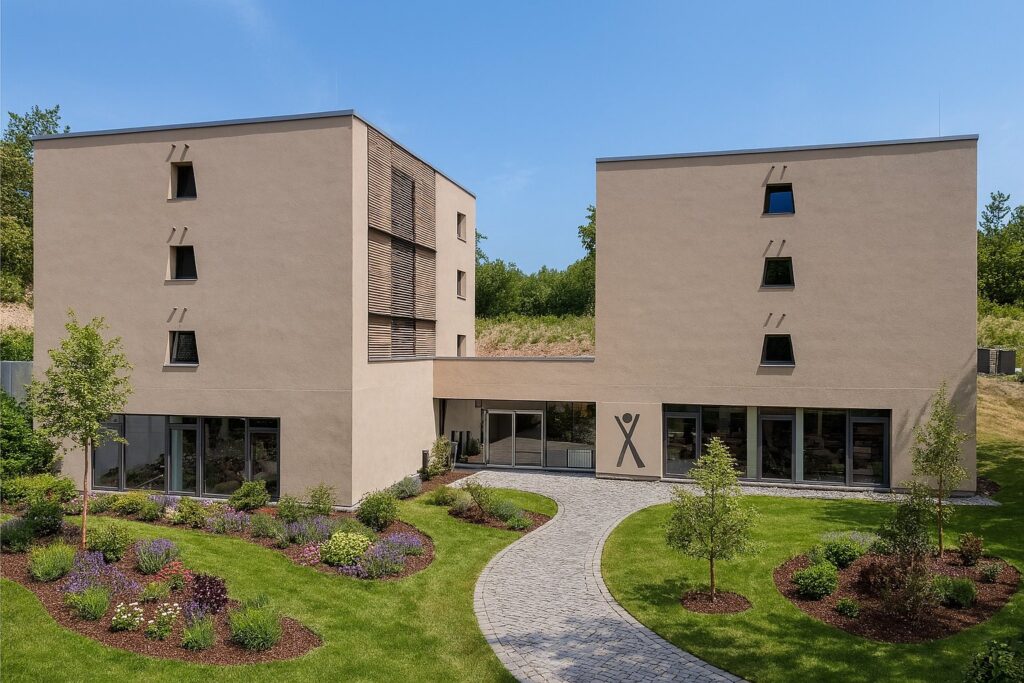
Before the XLAB Foundation’s new community center and residential wing is officially inaugurated, we are opening our doors exclusively to the neighborhood and the residents of Weende.
We cordially invite you to come see the new building at Stumpfen Eiche 20 for yourself on Sunday, December 14, from 2:00 to 5:00 p.m. .
Starting as early as Friday, December 12, 2025, anyone interested is cordially invited to attend a tour between 1:00 and 4:00 p.m.. This event is aimed particularly at the North Campus, but everyone is welcome to take a look behind the scenes.
Take this opportunity to explore the building’s architecture and atmosphere at your leisure. Designed by bez+kock Architekten, this complex—consisting of two striking residential towers—blends harmoniously into the hillside and creates a new connection between the Weende neighborhood and the North Campus.
What to expect:
- A Glimpse into the Architecture: Take a tour of the seminar rooms and the residential wing, which will soon serve as a “temporary home” for young STEM talents and XLAB participants from around the world.
- A Space for Connection: Discover how this place is becoming a hub for international exchange and collaborative learning.
- Exchange: Talk with representatives of the foundation and learn more about the work and goals of the XLAB Foundation.
We look forward to welcoming you on a tour!
November 14, 2025
XLAB Founder Eva-Maria Neher Receives the Silver Merchant's Spoon
The 74-year-old has been tirelessly dedicated to promoting science and education for more than 20 years / 150 guests attended the ceremony marking the 684th anniversary of the Göttingen Merchants’ Guild at the Old Town Hall
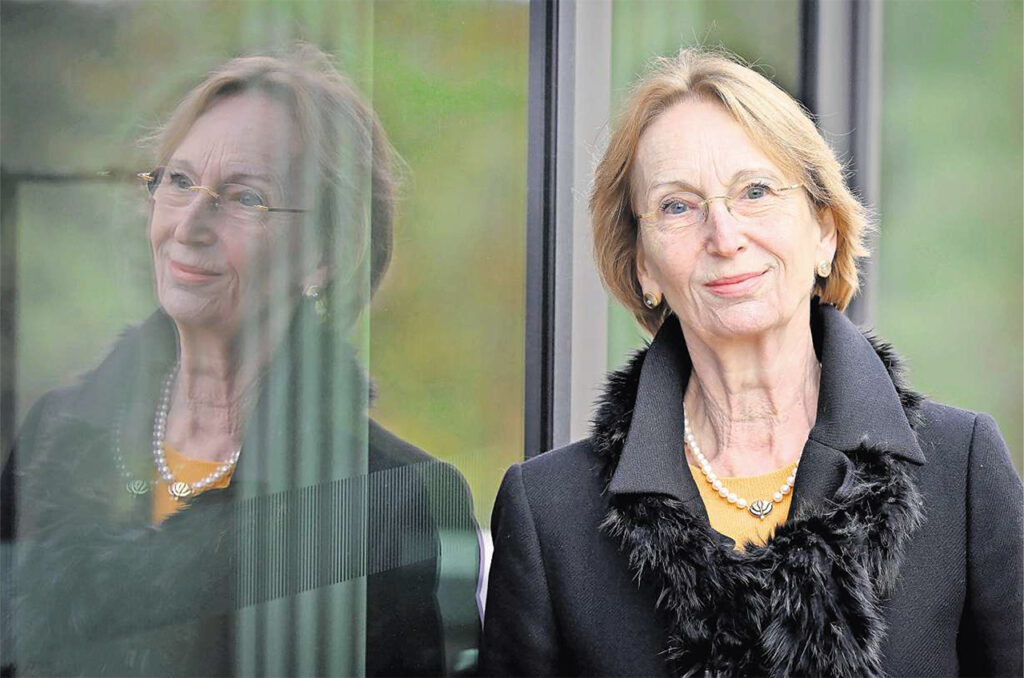
Foto: SWEN PFÖRTNER
Eva-Maria Neher was awarded the Silver Merchant’s Spoon in recognition of her decades of extraordinary dedication to promoting science and education in Göttingen. As the founder and long-time director of XLAB, she established one of Germany’s most significant student science labs, and today, as chair of the XLAB Foundation, she plays a key role in shaping the further development of the new community center. In his laudatory speech, Minister of Science Falko Mohrs highlighted Neher’s exemplary character and her extraordinary commitment. The 74-year-old is particularly looking forward to the upcoming opening of the new XLAB community center, which will offer young people modern spaces for research and learning.
September 19, 2025
Alexander von Humboldt Medal for Prof. Dr. Eva-Maria Neher
A special award for an extraordinary individual
The Society of German Natural Scientists and Physicians (GDNÄ) honored Prof. Dr. Eva-Maria Neher with the Alexander von Humboldt Medal at its 133rd annual meeting in Potsdam. The GDNÄ awards this medal to individuals who have made outstanding contributions to the advancement of the natural sciences, medicine, and technology, as well as to the further development of society.
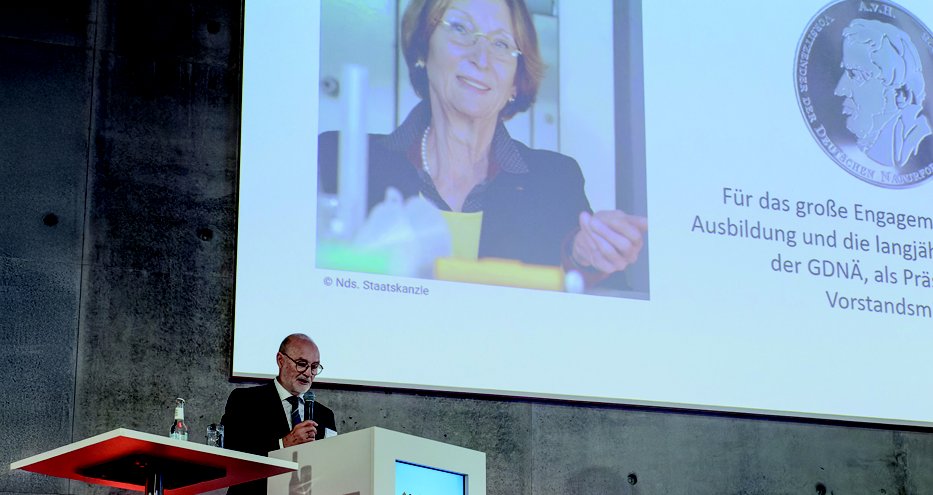
Eva-Maria Neher: Founder of XLAB
In 2000, Prof. Dr. Neher founded the XLAB – Göttingen Experimental Laboratory for Young People. Her vision was to provide young people with hands-on insights into the natural sciences. Since then, more than 200,000 students and teachers have visited the XLAB to conduct their own research and experiments there. She led the lab until 2018 and subsequently transferred it to the XLAB Foundation, which she continues to chair to this day.
With the XLAB Meeting Center, the foundation has created a space where international guests, school groups, and researchers can come together for seminars, projects, and cross-border exchanges.
Involvement in the GDNÄ and far beyond.
As president of the GDNÄ (2013–14), a member of the board, and an advisor, Eva-Maria Neher has had a decisive influence on this long-standing society. She significantly expanded the student program and made lasting contributions to promoting dialogue between the scientific community and young people.
In addition, she launched the XLAB Science Festival, which—much like the GDNÄ gatherings—brings together renowned scientists and young people.
Recognition of a Lifetime Achievement
The Alexander von Humboldt Medal joins an impressive list of honors:
- Niedersächsischer Verdienstorden
- Niedersächsischer Staatspreis
- Verdienstkreuz 1. Klasse der Bundesrepublik Deutschland
- Universitätsmedaille „Aureus Gottingensis“ der Universität Göttingen
The GDNÄ honored Eva-Maria Neher as “a role model par excellence”, who has inspired generations of students and fostered their enthusiasm for the natural sciences over the course of decades.
Congratulations from the XLAB Foundation
The XLAB Foundation extends its warmest congratulations to Prof. Dr. Eva-Maria Neher on receiving this prestigious award. Her tireless dedication to promoting the natural sciences, her visionary leadership, and her role as a bridge-builder between research, education, and society serve as an inspiration to many.
September 4, 2025
“XLAB Rosario: Prof. Dr. Eva-Maria Neher Strengthens International Network for Research-Based Learning”
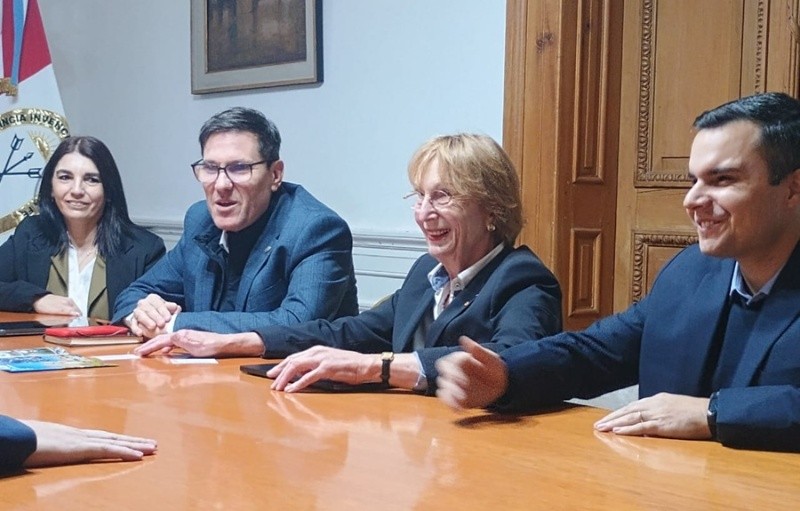
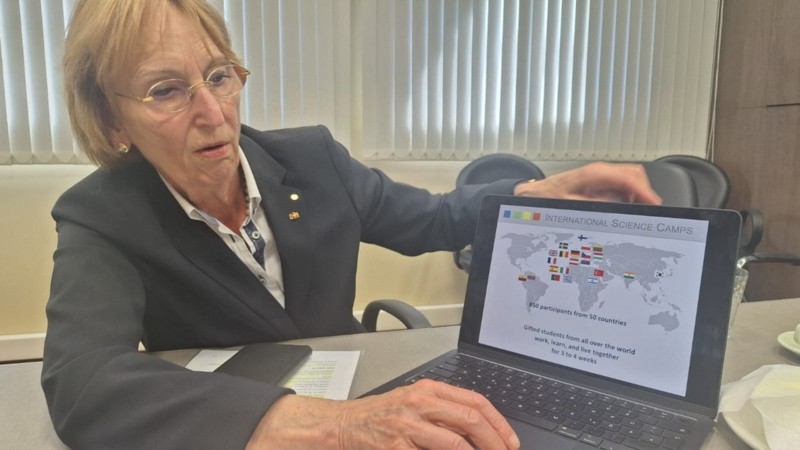
In the spring of 2025, Prof. Dr. Eva-Maria Neher, founder of XLAB Göttingen and chair of the XLAB Foundation, visited XLAB Rosario in Argentina. Since 2018, this first international partner laboratory of XLAB has been providing students and teachers with hands-on experience in scientific research—ranging from biology and chemistry to neuroscience.
During her visit, Prof. Dr. Neher spoke to a large group of teachers from the province of Santa Fe and emphasized the importance of inquiry-based learning: young people should not simply listen passively to scientific concepts, but experience them firsthand. XLAB Rosario has emerged as a key driving force in this regard: more than half of the participants decide to pursue studies in biology, medicine, or related fields after their visit.
The visit highlights how the Göttingen initiative, through international cooperation, inspires young people around the world for science and opens up new educational pathways in the long term.
20. März 2025
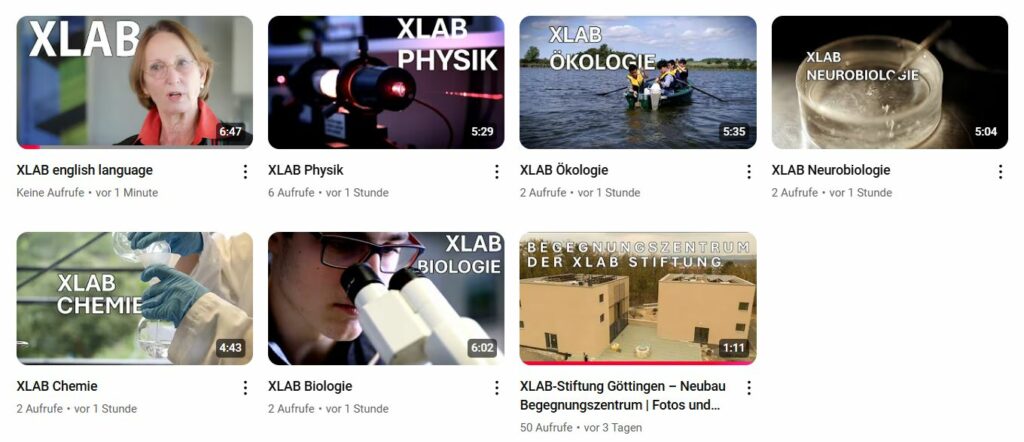
Discover the new YouTube channel of the XLAB Foundation now: https://www.youtube.com/@XLABStiftung. On this channel, we present authentic image films that offer an exciting insight into everyday life at XLAB - Göttingen Experimental Laboratory for Young People. Find out how our students and lecturers in the fields of biology, physics, ecology, neurobiology and chemistry promote the dialog between science and society with innovative experiments and projects. Subscribe to the channel to stay informed about the latest developments.
17. Februar 2025
Stellenanzeige: Vielseitige/r Koordinator/in im Begegnungszentrum
Die XLAB-Stiftung hat ein modernes Begegnungszentrum fast fertiggestellt – der Innenausbau ist nahezu abgeschlossen. Das Objekt umfasst 40 Betten, zwei geräumige Seminarräume mit moderner Technik, eine großzügige Küche, einen Speiseraum sowie mehrere Büros und einen Besprechungsraum. Zusätzlich ist das Gebäude mit einem Blockheizkraftwerk und zeitgemäßer Computer- und Medienausstattung ausgestattet.
Ihre Aufgaben:
Wir suchen mehrere engagierte Teammitglieder, die gemeinsam die vielfältigen Aufgaben im Begegnungszentrum übernehmen. Die konkrete Aufgabenverteilung erfolgt flexibel und wird vor Tätigkeitsantritt eindeutig definiert – eine feste Abgrenzung der Arbeitsfelder erfolgt erst nach der Kontaktaufnahme, wenn wir Ihre individuellen Stärken und Neigungen berücksichtigen. Mögliche Aufgabenbereiche umfassen:
- Technikmanagement: Hausmeistertätigkeiten, Ansprechpartner/in für Fachfirmen und Versorgungsanbieter.
- Veranstaltungsmanagement: Koordination der Gäste, Kommunikation mit nationalen und internationalen Anfragenden sowie Vermietung von Seminarräumen, Speiseraum etc.
- Assistenz der Geschäftsführung: Unterstützung in administrativen und organisatorischen Aufgaben.
- Rechnungswesen: Einkauf, Buchführung und weitere buchhalterische Tätigkeiten.
- IT & EDV-Service: Betreuung von Hard- und Software sowie Pflege der Kontakte zur GWDG und zu Medienversorgern.
- Service im Übernachtungsbetrieb und Restaurant: Operative Unterstützung im Gäste- und Bewirtungsbereich.
Start:
Zum nächstmöglichen Zeitpunkt
Bewerbungsunterlagen:
Bitte senden Sie Ihre vollständigen Bewerbungsunterlagen – gern auch in elektronischer Form – an:
XLAB-Stiftung
Prof. Dr. Eva-Maria Neher
Justus-von-Liebig-Weg 3
37077 Göttingen
E-Mail: Neher@xlab-stiftung.de
Wir freuen uns darauf, gemeinsam im Team die vielfältigen Aufgaben im Begegnungszentrum flexibel und entsprechend Ihrer Stärken zu gestalten!
30. Januar 2025
Erfolgreiches XLAB Science Festival 2025 in Göttingen
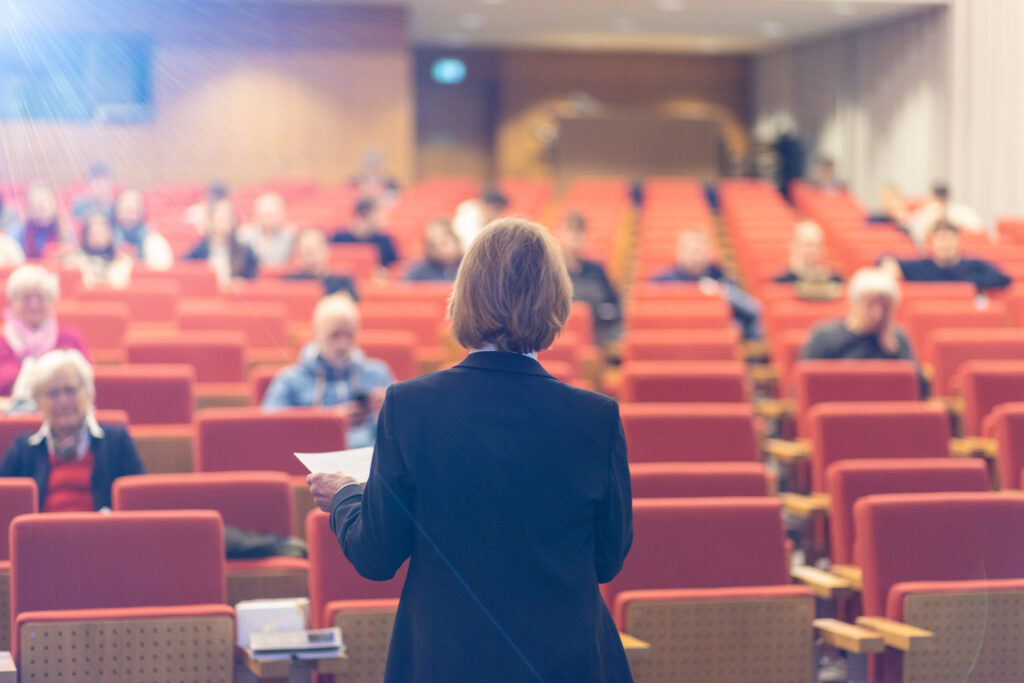
On January 29 and 30, 2025, the XLAB Science Festival took place in Göttingen with great success. The event offered exciting scientific presentations. Prof. Dr. Eva-Maria Neher, founder of the XLAB and Chair of the Board of the organizing XLAB Foundation, led the program and emphasized the importance of science education for young people in her opening speech.
The Abendveranstaltung wurde live übertragen and can still be viewed on the YouTube channel of the Georg-August-Universität Göttingen. This means that anyone interested who was unable to attend the event can watch the lecture in full.
The highlight of the evening was the presentation by Prof. Dr. Martin J. Lohsea renowned scientist in the field of pharmacology. He spoke about drugs with new mechanisms of action and explained how
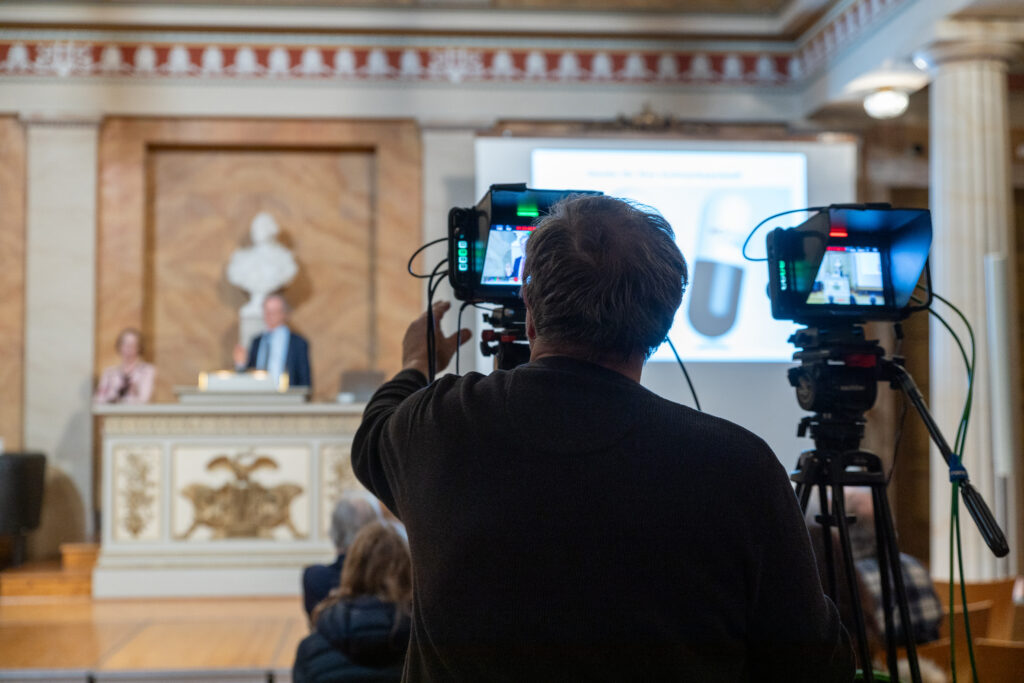
innovative drugs can specifically intervene in biological processes. He also addressed the fascinating Power of placebos and explained the astonishing effects these placebo drugs can have on the human body. His lecture impressively demonstrated how strongly psychological factors influence the effectiveness of medication.
Highlights of the presentations
Seven outstanding scientists from various disciplines gave insights into their research:
Prof. Dr. Holger Stark
(Max-Planck-Institut für Multidisziplinäre Naturwissenschaften)
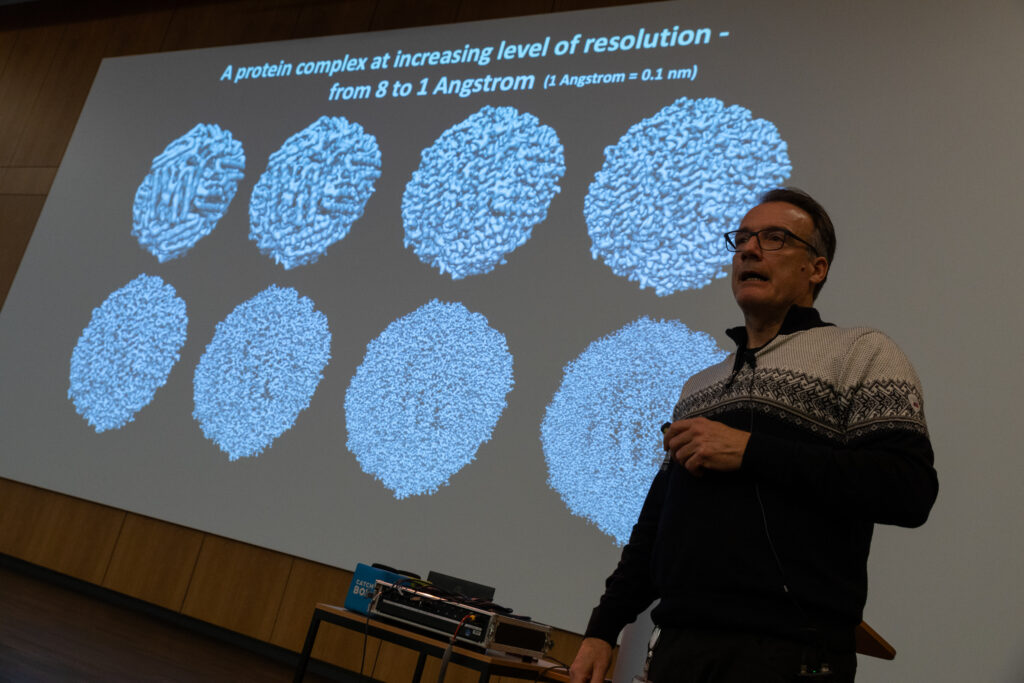
- Entwicklung der Mikroskopie: Vom Lesestein bis zum leistungsstärksten Elektronenmikroskop
- Fortschritte in der optischen Technik als Weg zur Entdeckung neuer Strukturen
- Bedeutung einer präzisen Sichtweise, um Fehldeutungen wissenschaftlicher Daten zu vermeiden
Prof. Dr. Dr. h.c. Christian Griesinger
(Max-Planck-Institut für Multidisziplinäre Naturwissenschaften)
- Kernmagnetische Resonanz (NMR) zur Untersuchung von Biomolekülen
- Analyse von Protein-Aggregationen bei neurodegenerativen Erkrankungen (z. B. Parkinson, Alzheimer)
- Entwicklung therapeutischer Moleküle zur Neutralisierung toxischer Protein-Aggregate
Prof. Dr. Martin Wikelski
(Max-Planck-Institut für Verhaltensbiologie, Konstanz/Radolfzell)
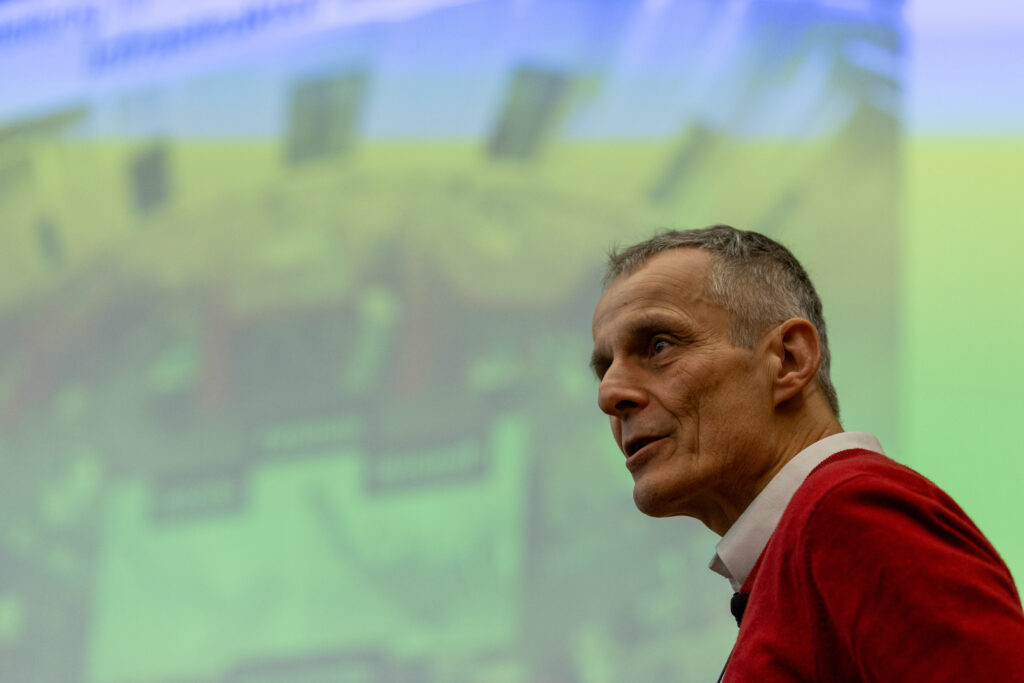
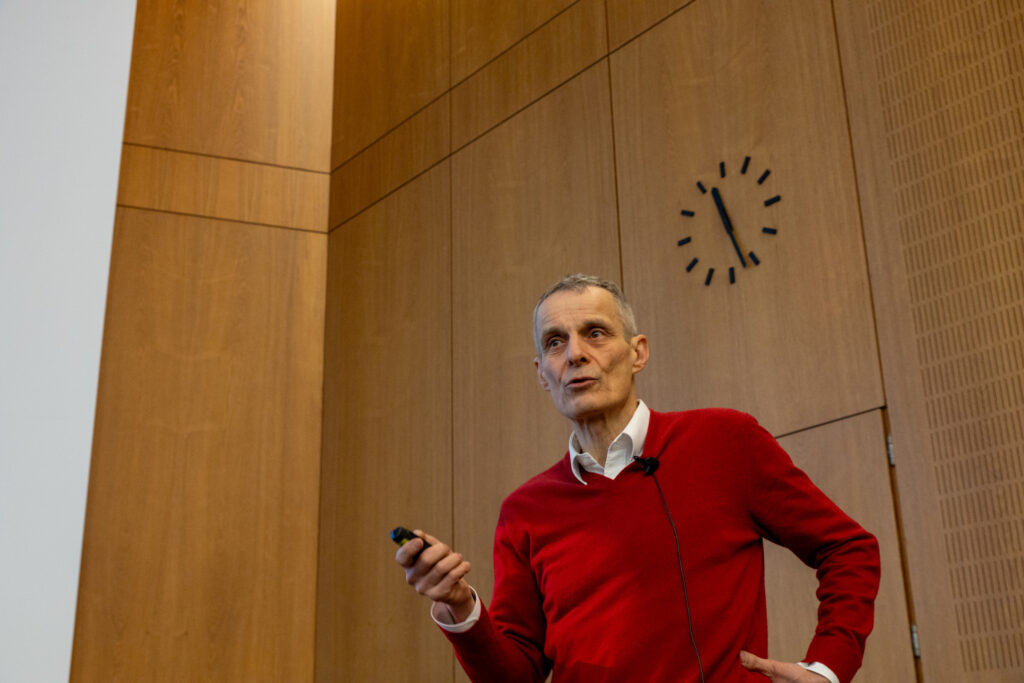
- „Internet der Tiere“: Einsatz von Sensoren zur globalen Überwachung von Wildtieren
- Tiere als Frühwarnsysteme für Naturkatastrophen und Zoonosen
- ICARUS-Projekt und Open-Source-Datenbank Movebank für ökologische Forschung
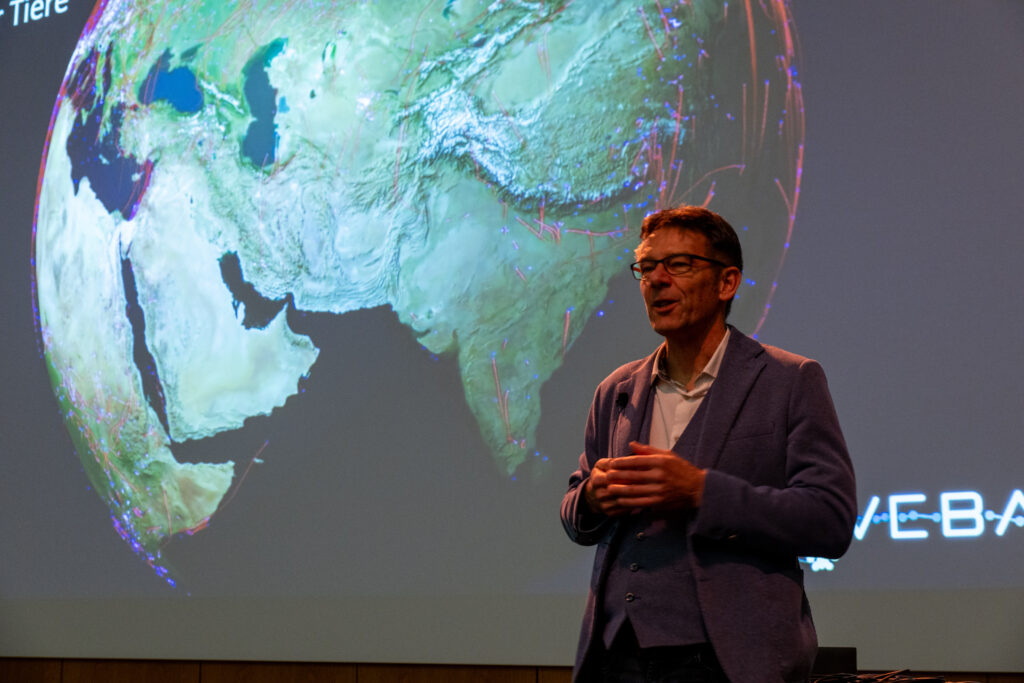
Prof. Dr. Martin J. Lohse
(ISAR Bioscience Institut, München & Universität Würzburg)
- Entwicklung und Zukunft der Arzneimitteltherapie
- Klassische und neue Wirkstoffklassen: Kleine Moleküle, Antikörper, RNA-basierte Medikamente
- Herausforderungen der Arzneimittelverordnung: Wirksamkeit, Kosten, Verfügbarkeit
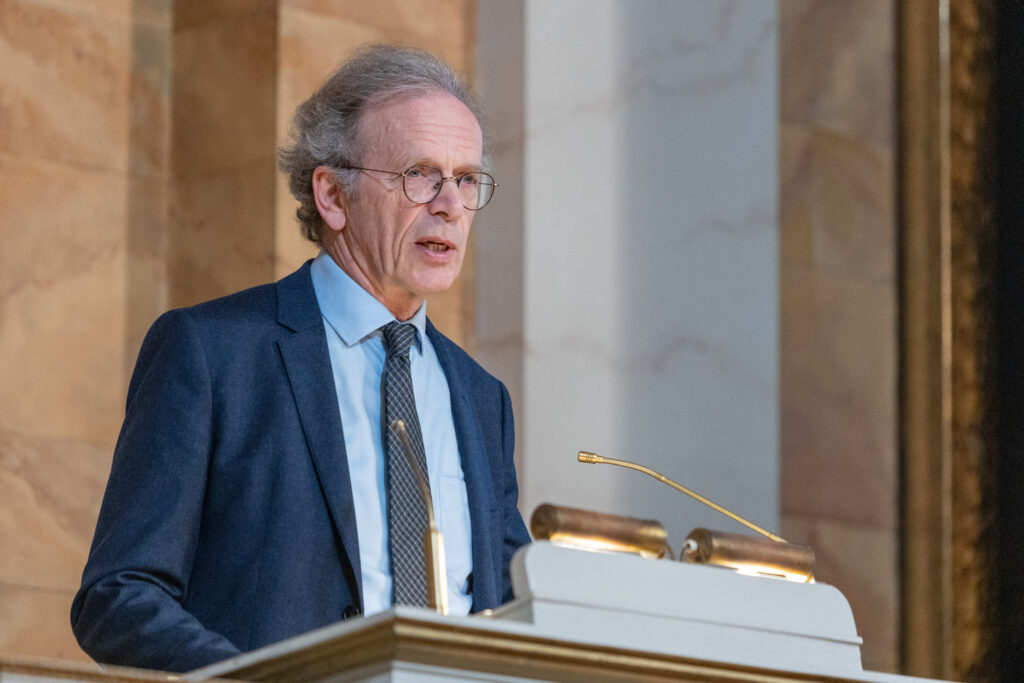
Prof. Dr. Heribert Hofer
(Leibniz-Institut für Zoo- und Wildtierforschung)
- „Mensch-Raubtier-Konflikte“: Beispiel Wolf in Deutschland
- Wissenschaftliche Strategien zur Konfliktlösung zwischen Menschen und Raubtieren
- Bedeutung von Forschung und Kooperation für den langfristigen Erhalt bedrohter Arten
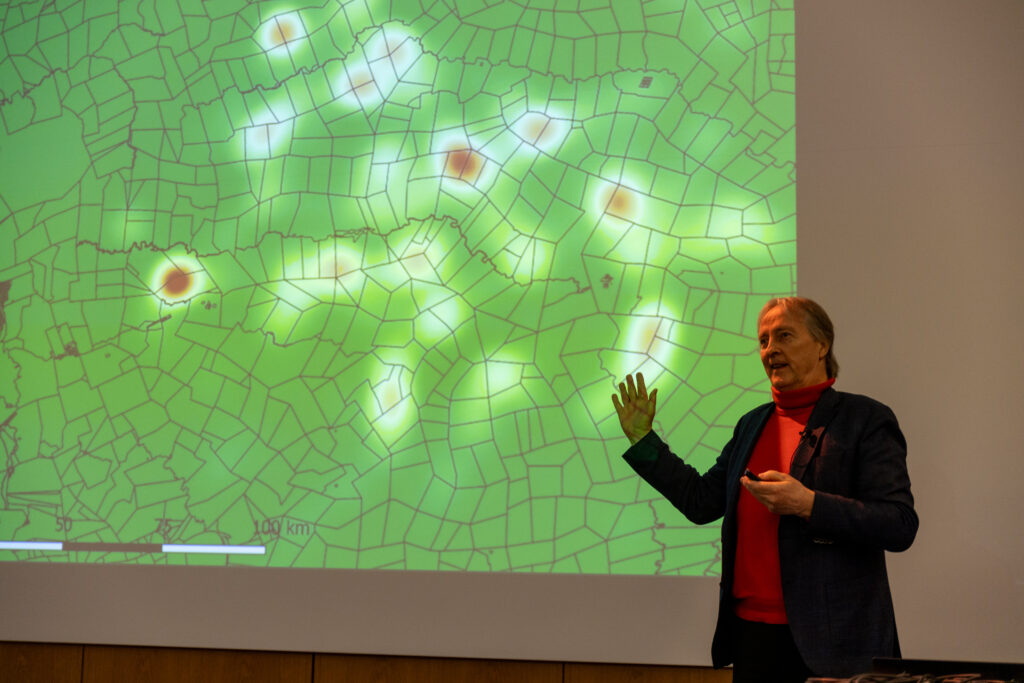
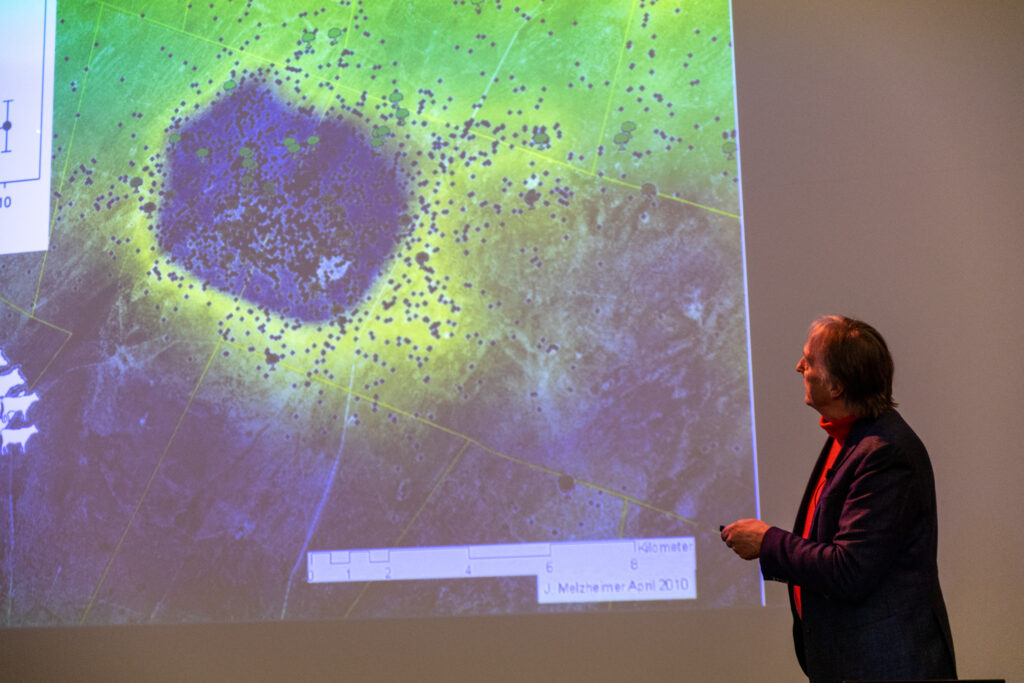
Prof. Dr. Ariane Frey
(Universität Göttingen)
- Materie vs. Antimaterie: Warum existiert mehr Materie im Universum?
- Experimente mit beauty-Hadronen am LHC (Genf) und SuperKEKB (Japan)
- Untersuchung der Symmetrieverletzung als Erklärung für die Existenz der Materie
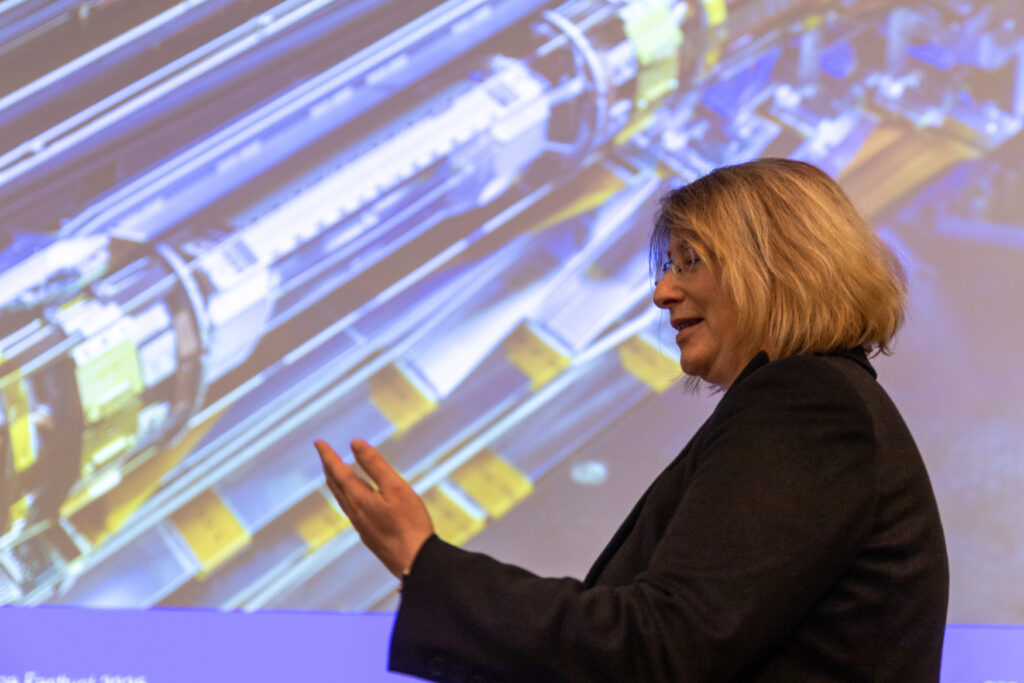
Prof. Dr. Lutz Ackermann
(Friedrich-Wöhler-Forschungsinstitut, Universität Göttingen)
- Nachhaltige Chemie: Ressourcenschonende Produktionsprozesse
- Alternativen zu fossilen Rohstoffen in der Chemieindustrie
- Strategien zur Reduzierung von Umweltverschmutzung und Treibhausgasemissionen
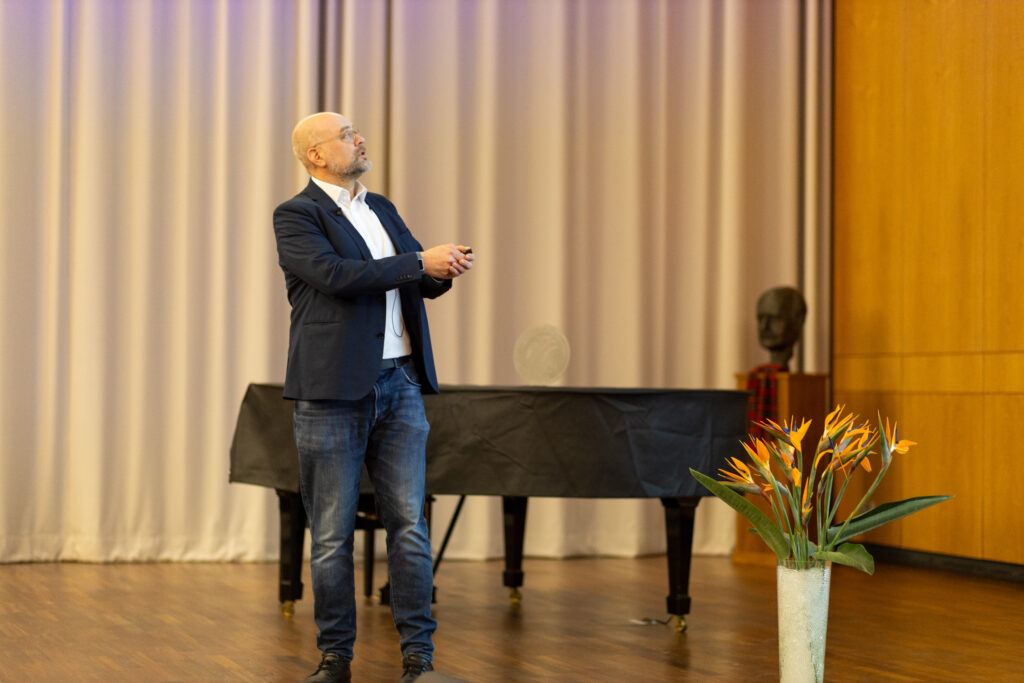
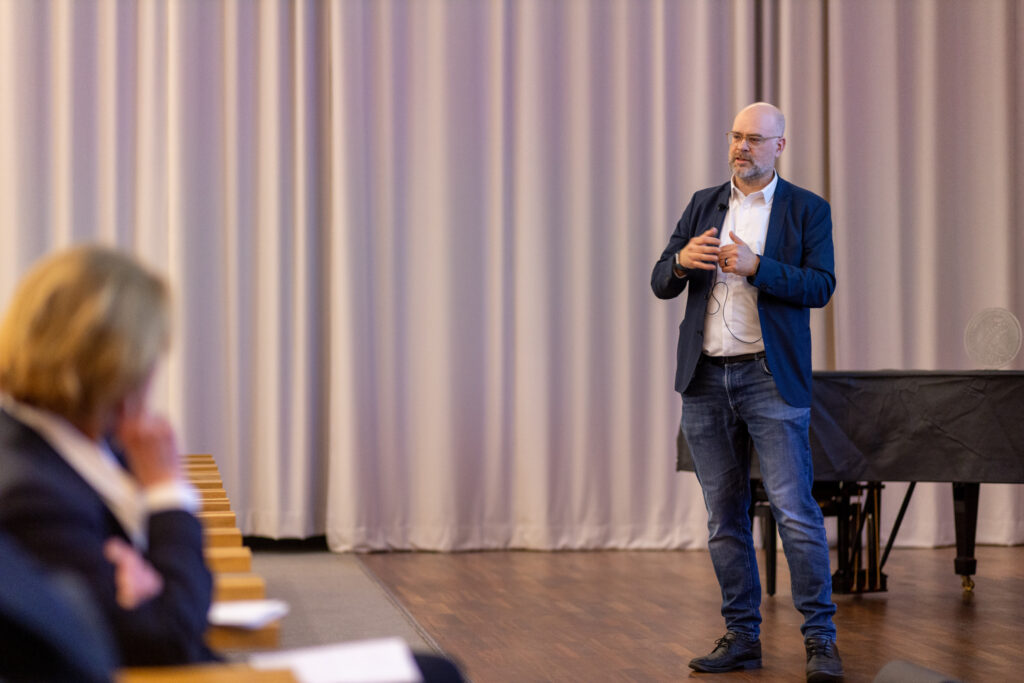
Das XLAB Science Festival 2025 bot faszinierende Einblicke in aktuelle wissenschaftliche Entwicklungen und inspirierte zahlreiche Besucherinnen und Besucher. Die Mischung aus hochkarätigen Vorträgen und interaktiven Diskussionen machte die Veranstaltung zu einem vollen Erfolg.
Die Organisatoren bedanken sich bei allen Teilnehmenden und freuen sich auf das nächste XLAB Science Festival!
23. Januar 2025
STREAM:
Abendveranstaltung in der Aula der Universität Göttingen
Prof. Dr. Martin J. Lohse
ISAR Bioscience Institut, Planegg/München und Universität Würzburg/TU München
Arzneimittel: Neue Wirkmechanismen und die Kraft von Placebos
29. Januar 2025 18:00 Uhr
24. November 2024
Neuigkeiten zum XLAB Science Festival 2025
D
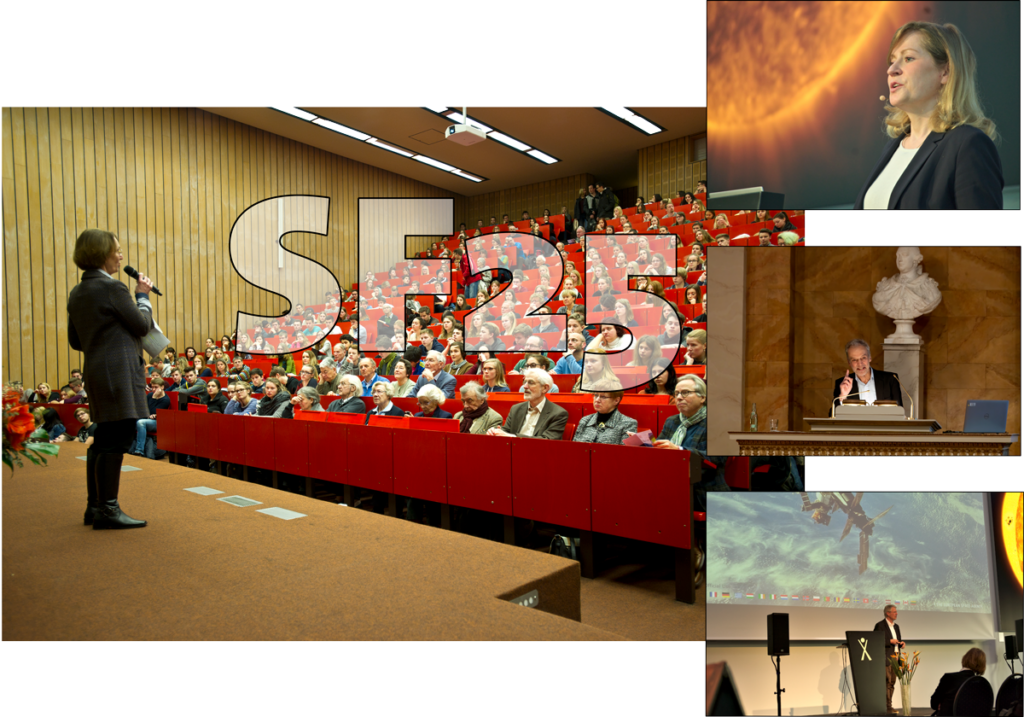
ie Science Festival-Seite wurde aktualisiert, und wir freuen uns, Ihnen erste Informationen zum XLAB Science Festival 2025 präsentieren zu können!
Das Festival findet am Mittwoch, den 29. Januar, und Donnerstag, den 30. Januar 2025, in Göttingen statt. Erleben Sie spannende naturwissenschaftliche und geisteswissenschaftliche Vorträge an einem inspirierenden Ort – dem Max-Planck-Institut für Multidisziplinäre Naturwissenschaften.
Dieses jährliche Highlight bietet eine hervorragende Gelegenheit für alle Wissenschaftsbegeisterten, neue Erkenntnisse zu gewinnen und sich mit Gleichgesinnten auszutauschen. Wir laden Sie ein, sich den Termin vorzumerken und regelmäßig die Science Festival-Seite zu besuchen, um aktuelle Informationen zum Programm und zur Anmeldung zu erhalten.
Freuen Sie sich auf faszinierende Tage voller Wissenschaft! Weitere Details finden Sie [hier]Link zur Science Festival-Seite).
17. Oktober 2024
Prof. Dr. Eva-Maria Neher mit der Alexander von Humboldt-Medaille ausgezeichnet
W
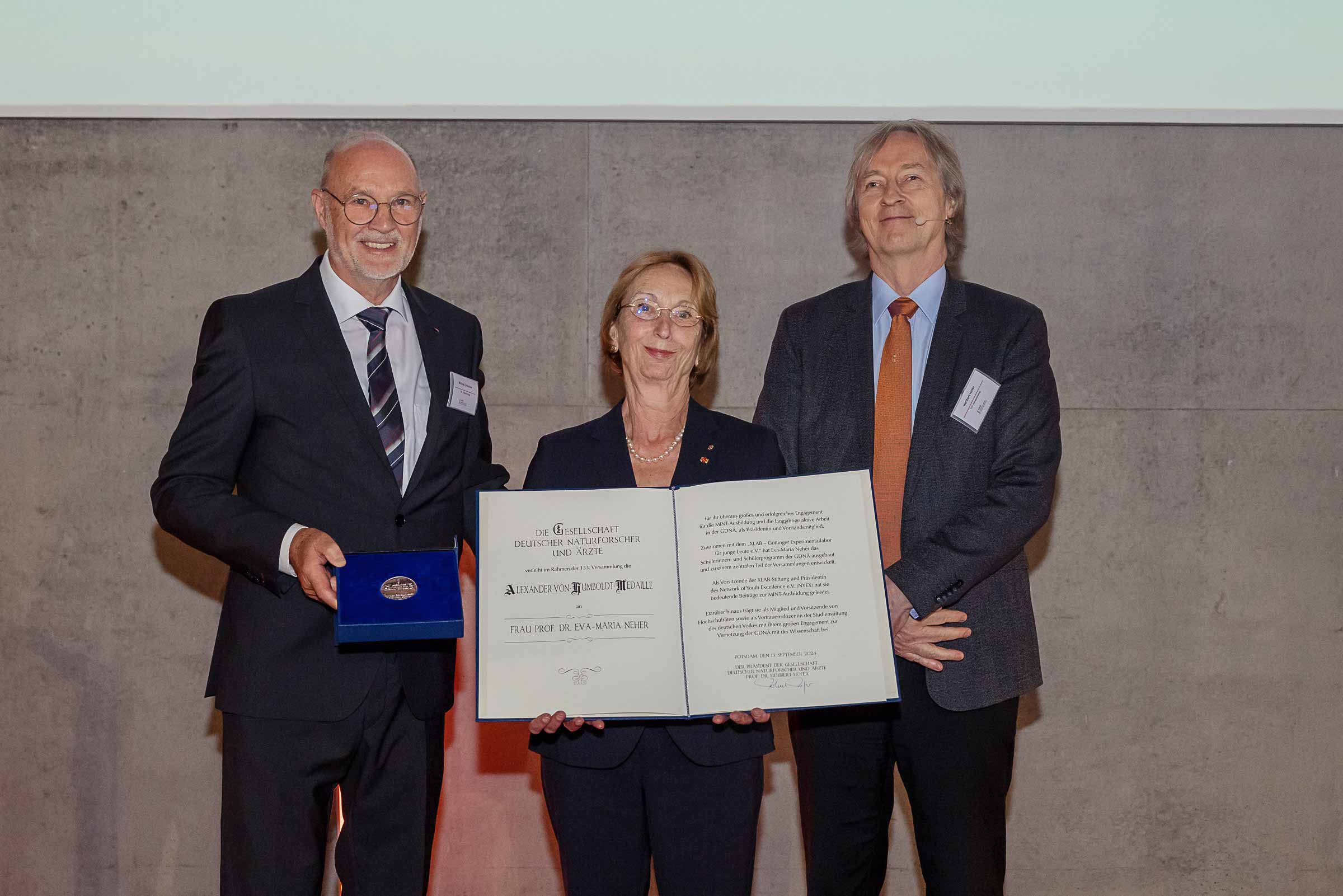
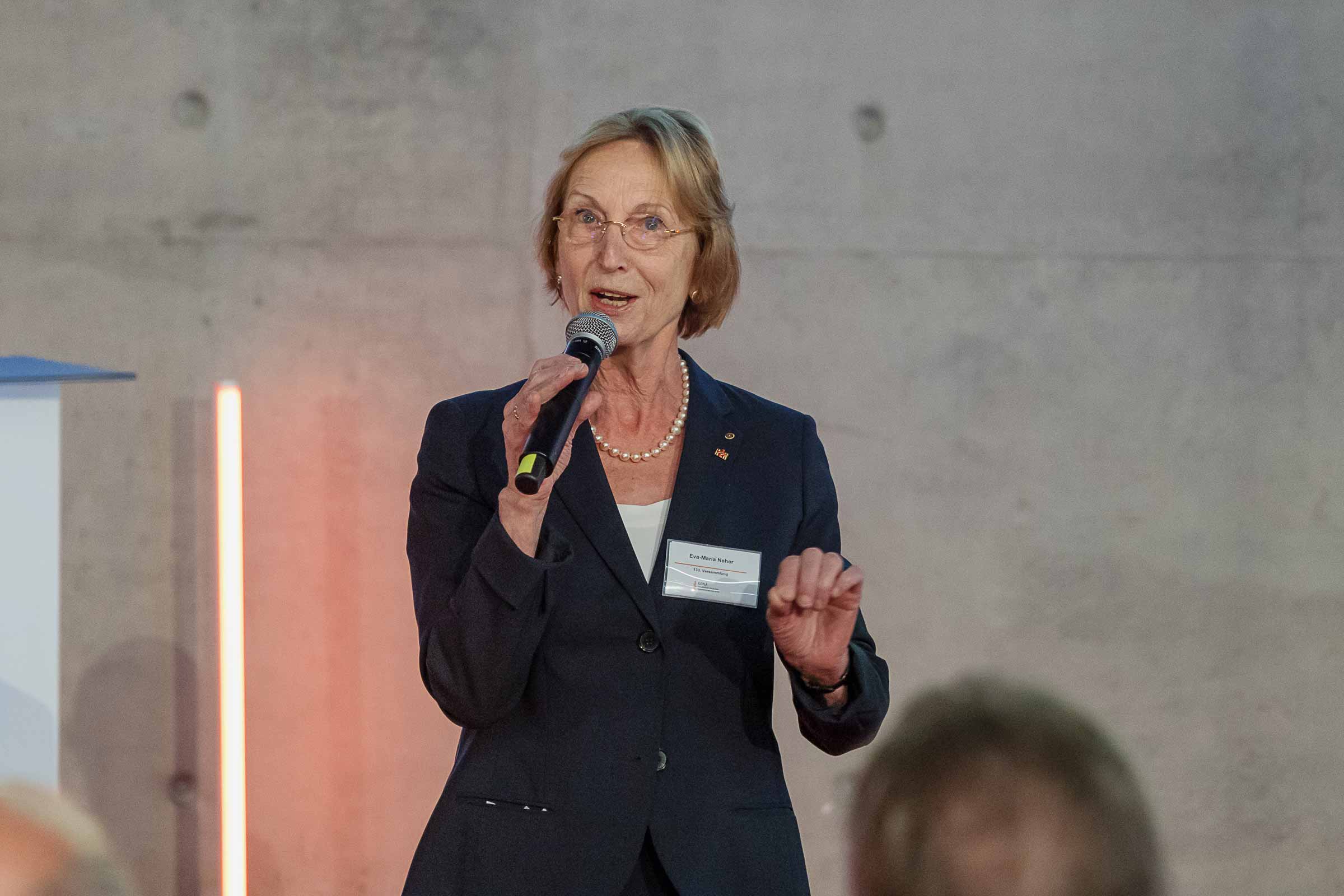
e are delighted that our Chairwoman of the XLAB Foundation, Prof. Dr. Eva-Maria Neher, has been awarded the Alexander von Humboldt Medal of the Society of German Natural Scientists and Physicians (GDNÄ). The award ceremony took place as part of the 133rd GDNÄ Assembly on September 13, 2024 on the Griebnitzsee campus of the University of Potsdam. Prof. Dr. Neher received the award for her outstanding achievements in science education and her special commitment as president and board member of the GDNÄ. In his laudatory speech, the current President of the GDNÄ, Prof. Heribert Hofer, highlighted her great services to the mathematical and scientific education of young people. Under her leadership, the GDNÄ's student program was developed into a central component of the annual meetings.
Prof. Dr. Neher erhielt die Auszeichnung für ihre herausragenden Leistungen in der naturwissenschaftlichen Bildung und ihr besonderes Engagement als Präsidentin und Vorstandsmitglied der GDNÄ. Der amtierende Präsident der GDNÄ, Prof. Heribert Hofer, hob in seiner Laudatio ihre großen Verdienste um die mathematisch-naturwissenschaftliche Bildung junger Menschen hervor. Unter ihrer Leitung wurde das Schülerinnen und Schüler-Programm der GDNÄ zu einem zentralen Bestandteil der Jahresversammlungen entwickelt.
About the Alexander von Humboldt Medal
The Alexander von Humboldt Medal has been awarded every two years since 2010 to individuals who have made a special contribution to the development of the GDNÄ. It commemorates the famous natural scientist Alexander von Humboldt (1769-1859), who was instrumental in the early development of the GDNÄ.
About Prof. Dr. Eva-Maria Neher
Prof. Dr. Eva-Maria Neher studied biology, biochemistry, organic chemistry and microbiology in Göttingen and received her doctorate in 1977. In 2000, she founded the XLAB - Göttinger Experimentallabor für junge Leute e.V. and headed it until 2018. She has been Chairwoman of the XLAB Foundation since 2008. She is also involved in various committees and organizations, including as Chair of the University Council of the European University of Flensburg and as a board member of the GDNÄ. She has been honored several times for her outstanding social and scientific commitment.
We warmly congratulate Prof. Dr. Neher on this well-deserved award and are proud of her tireless efforts to promote science education.
22. August 2024
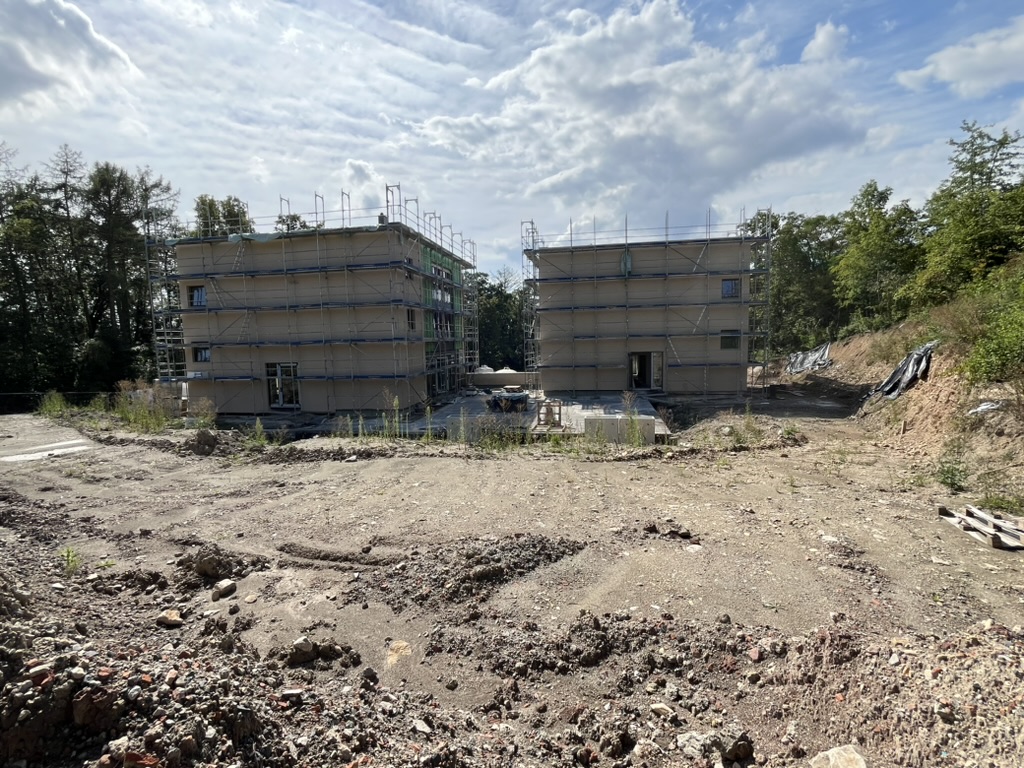
Construction progress of the communication center
Dthe construction of the communication center is progressing well. The colored scratch plaster already gives the building a prestigious appearance. The building is still covered in scaffolding as the work on the roof, in particular the installation of the solar cells and the green roof, still requires this. Work on the interior is also progressing at full speed.
We expect to be able to put the center into operation in December or January and look forward to presenting you with a further update with new images once the scaffolding has been dismantled.

28. Juni 2024
Interior work and final spurt
DThe interior work on the new XLAB communication center in Göttingen-Weende is in the final spurt. Work is progressing rapidly and the goal of completion at the end of 2024 or beginning of 2025 is getting closer and closer. The photos show the final construction phases in which the interior work is being completed. Soon the center will provide an innovative and inspiring environment for students, scientists and the entire community. The XLAB community is looking forward to opening the doors of the new communication center soon and promoting the exchange between school and research.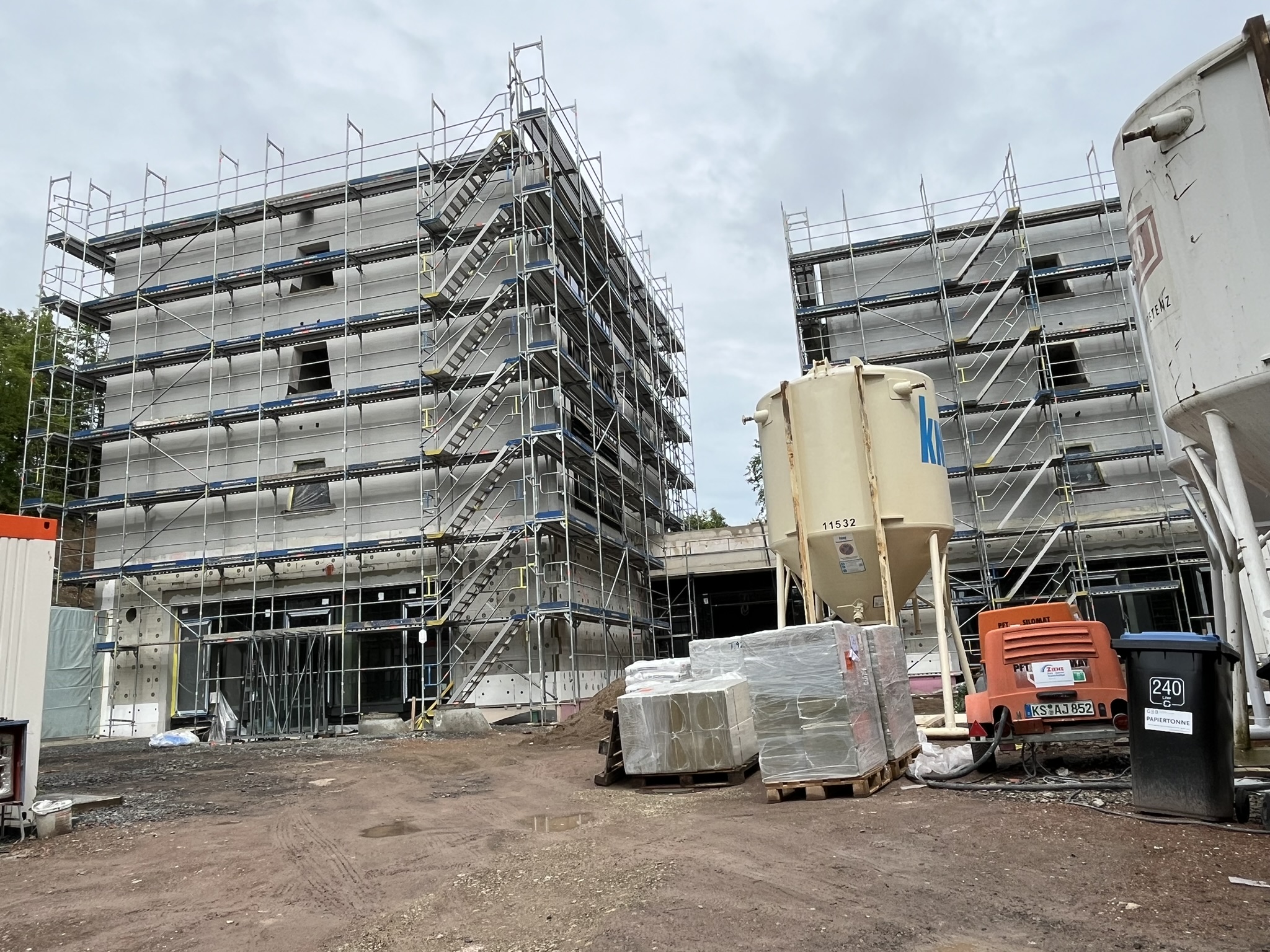


24. November 2023
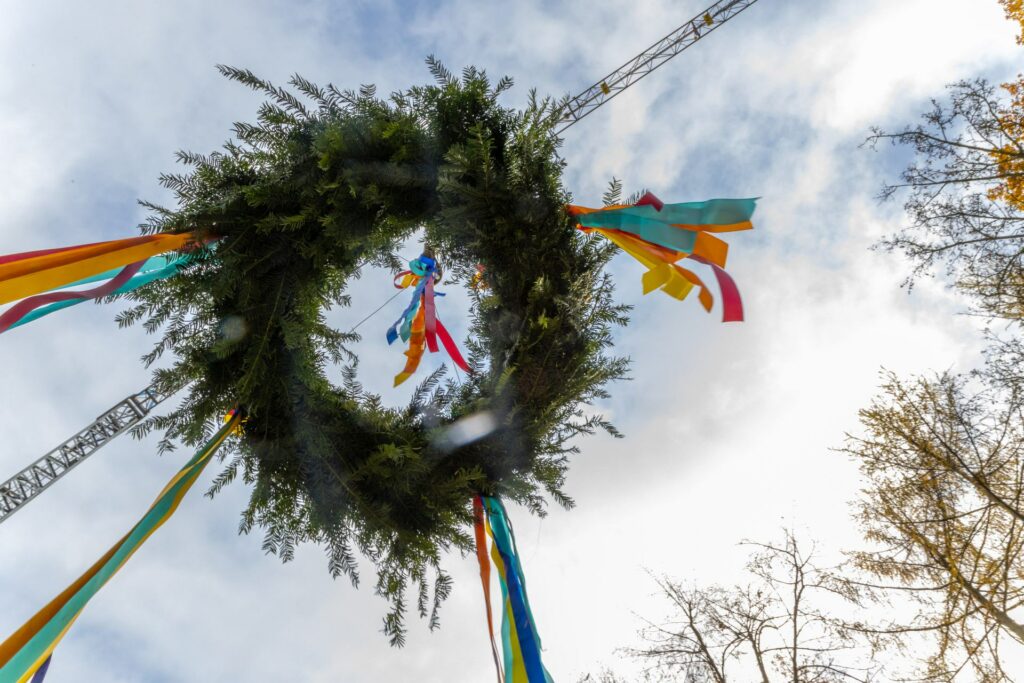
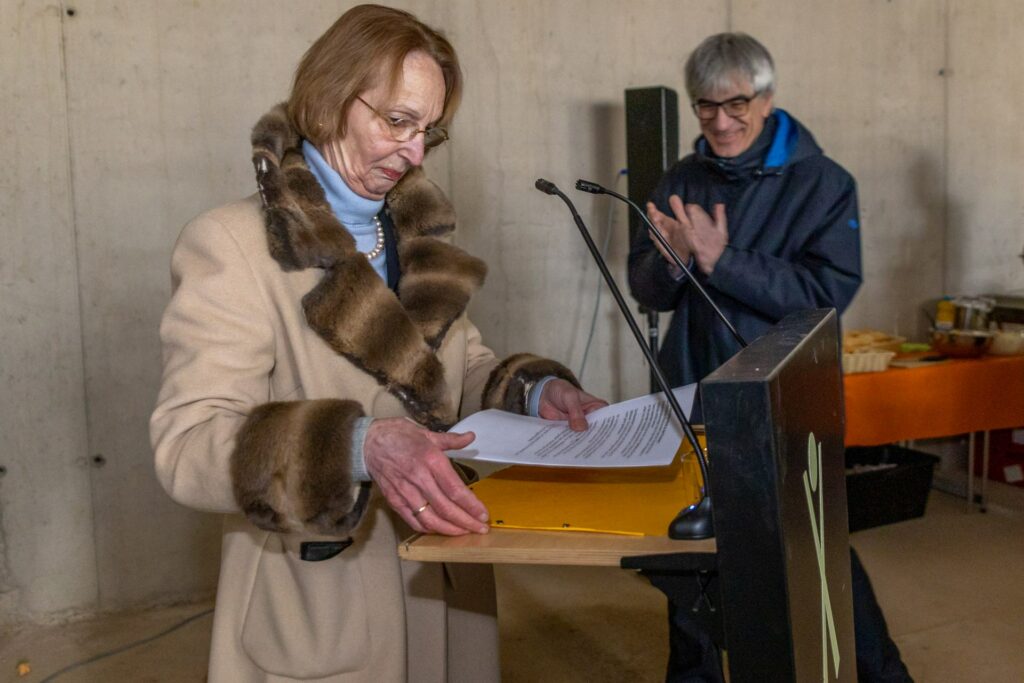
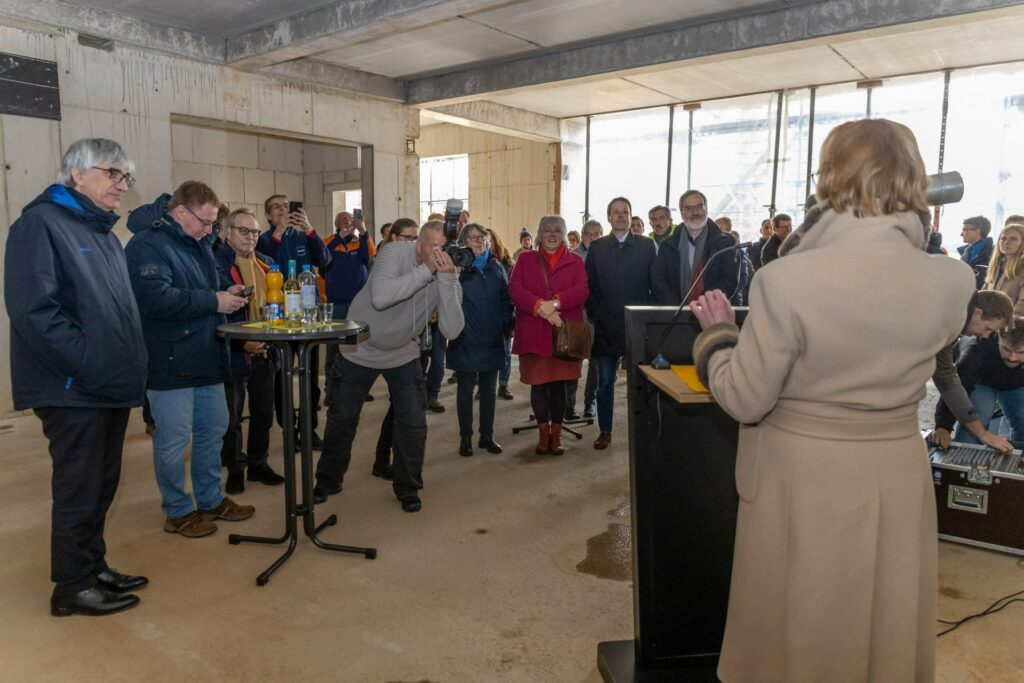
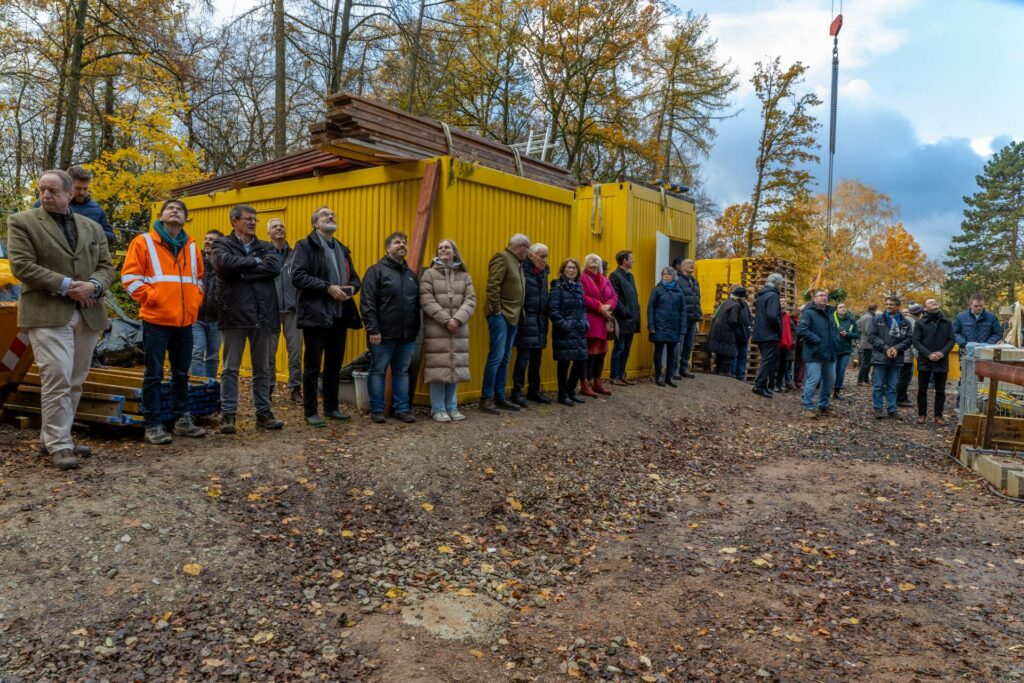
Richtfest für das neue Kommunikationszentrum des XLAB in Göttingen Weende
Mit dem Richtfest für ihr neues Kommunikationszentrum in Göttingen Weende feierte die XLAB-Stiftung am Freitag den 24. November ein wichtiges Ereignis. Die Veranstaltung, an der hochrangige Persönlichkeiten und Ehrengäste teilnahmen, markierte einen Meilenstein in der Entwicklung der Bildungseinrichtung.Das Richtfest, das von Prof. Dr. Eva-Maria Neher, der Vorsitzenden der XLAB-Stiftung eröffnet wurde, bot eine Plattform, um den sehr langen und steinigen Weg bis zur Fertigstellung des Kommunikationszentrums zu würdigen. In ihrer bewegenden Rede betonte Frau Neher nicht nur die Bedeutung des neuen Zentrums für die Bildungslandschaft, sondern auch seine zukünftige Rolle als Bindeglied zwischen Wissenschaft, Bildungseinrichtungen, Schülern und Wissenschaftlern. Es soll ein Knotenpunkt für Innovation, interaktives Lernen und den Austausch zwischen Schule und Forschung werden.
Unter den prominenten Gästen waren hochrangige Vertreter der Stadt Göttingen, der Präsident und die Vizepräsidentin der Universität Göttingen sowie der Direktor des Deutschen Primatenzentrums und die Architekten des Kommunikationszentrums vom Büro Bez+Kock , Stuttgart, Herr Bez, Herr Bossog und Herr Beilharz, sowie die am Bau Beteiligten des Universitätsbaumanagements waren anwesend, um diesen wichtigen Moment zu würdigen.
Der Universitätspräsident , Prof. Tolan, berichtete, dass ihm die Universität Göttingen vor seinem Amtsantritt als Präsident der Georg-August-Universität Göttingen vor allem durch das renommierte und deutschlandweit einzigartige Schülerlabor XLAB aufgefallen sei. Er unterstrich in der Rede seine Unterstützung für Bildungseinrichtungen wie das Schülerlabor XLAB.
Das XLAB Experimentalabor und die XLAB-Stiftung sind stolz, diesen Meilenstein erreicht zu haben und freuen sich auf die zukünftigen Möglichkeiten, die das Kommunikationszentrum bietet, um Wissen, Innovation und Kooperation weiter voranzutreiben.
Das Kommunikationszentrum strebt eine vollständige Fertigstellung im Herbst 2024 oder zu Beginn des Jahres 2025 an. Die XLAB-Gemeinschaft freut sich darauf, diesen Meilenstein in der Bildung und Zusammenarbeit zureichen. Mit diesem Zeitplan im Blick wird das Zentrum seine Türen öffnen, um Schülern, Wissenschaftlern und der gesamten Gemeinschaft eine innovative und inspirierende Umgebung zu bieten.

23. Oktober 2023
Rohbau sehr kurz vor Fertigstellung
Ein paar Arbeiten müssen noch gemacht werden.
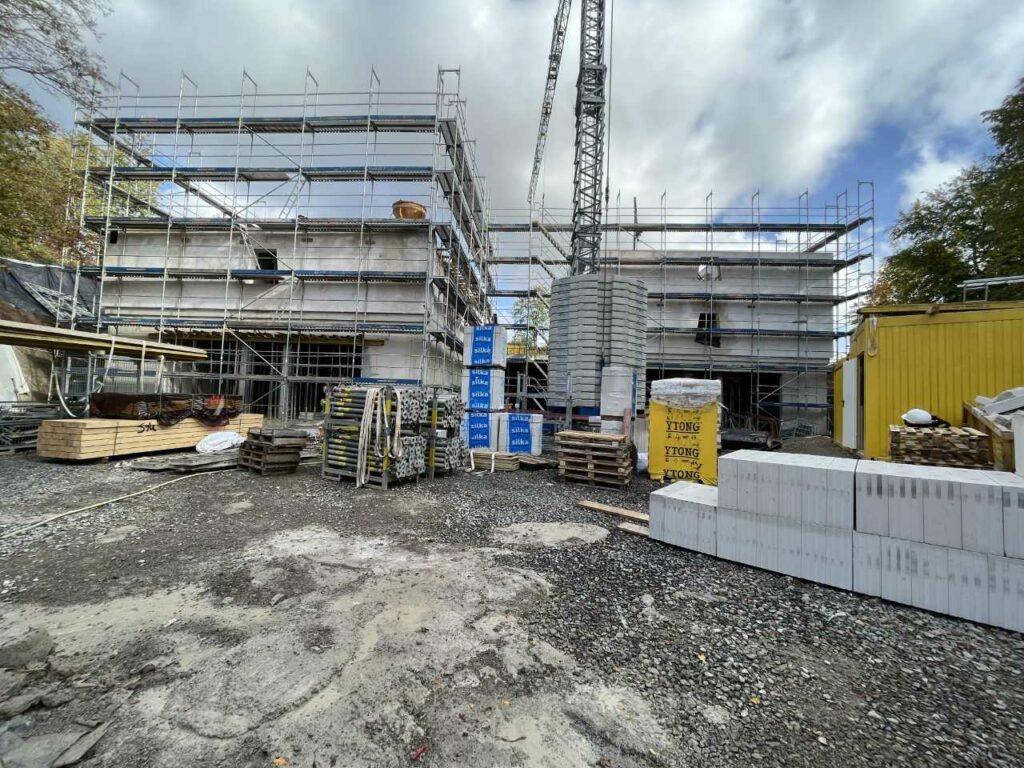
2. Oktober 2023
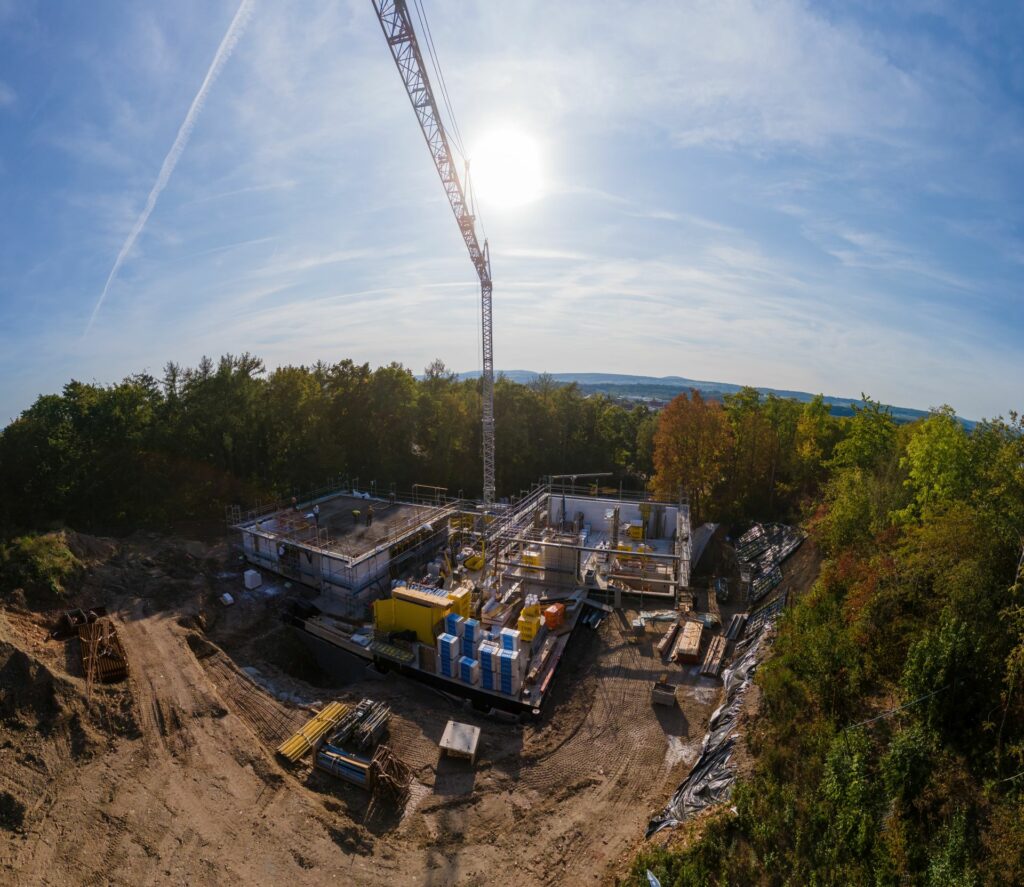
Rohbau kurz vor Fertigstellung
Die Fotos zeigen die beiden Türme vor der Fertigstellung


19. April 2023
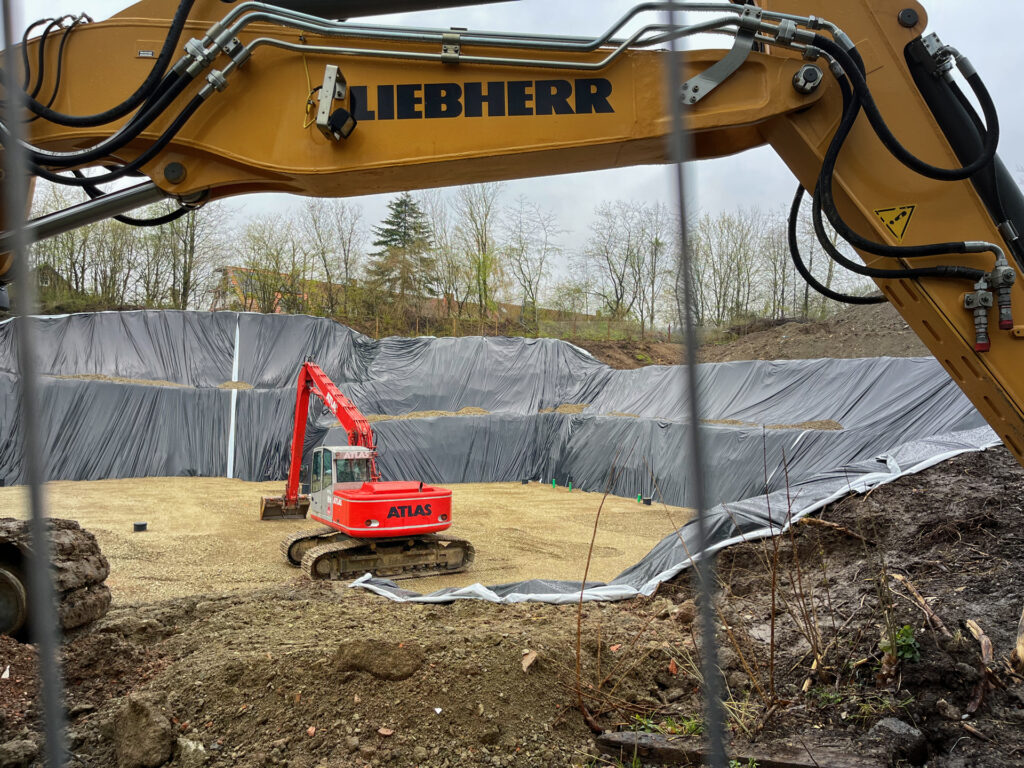
Vorbereitung des Fundaments
Das Foto zeigt eine wichtige Phase des Bauprozesses – die Vorbereitung der Fundamente. Ein großer Bagger steht in einer tief ausgehobenen Baugrube, die mit einer stabilen Böschungssicherung gesichert ist. Die Plane sorgt dafür, dass die Seitenwände der Grube stabil bleiben und die Erdmassen nicht abrutschen. Die Böschungssicherung ist ein wichtiger Schutzmechanismus, der die Sicherheit aller Arbeiter auf der Baustelle gewährleistet.
12. April 2023
Es geht voran!
Der Countdown zum Bau des Begegnungszentrums für das XLAB ist nun offiziell abgelaufen! Wir freuen uns, Ihnen mitteilen zu können, dass die Bauarbeiten begonnen haben. Unser Video zeigt, wie zwei Bagger hart arbeiten, um die Baugrube auszuschachten und das Gelände für den Bau vorzubereiten.
10. März 2023
Erweiterungsbau: Erster Spatenstich
Viele Hürden musste die Stiftung XLAB überwinden, um den geplanten Erweiterungsbau des XLAB Begegnungszentrum zu realisieren. Am Freitag erfolgte der erste Spatenstich für das zweite Gebäude des Experimentallabors in Göttingen-Weende. Architekt Martin Bez (Architekten Bez und Kock) betonte, dass dies ein großer Schritt auf einem langen und anspruchsvollen Weg sei. Der Erweiterungsbau umfasst zusätzliche Seminarräume, Labore und einen Wohntrakt, um die Kapazitäten des XLAB zu erhöhen. Ziel ist es, das Begegnungszentrum des Experimentallabors Anfang 2025 zu eröffnen.
Die Gründerin des XLAB und Vorsitzende der XLAB-Stiftung, Eva-Maria Neher, betonte, dass der Neubau eine architektonische Aufwertung für Göttingen darstelle und eine Verbindung zwischen dem Stadtteil Weende und dem naturwissenschaftlichen Campus schaffe. In den 16 Zimmern des Wohntraktes können bis zu 64 junge Menschen übernachten und mit erfahrenen Wissenschaftlern in Kontakt treten, um von ihnen zu lernen.
Der niedersächsische Wissenschaftsminister Falko Mohrs (SPD) betonte die Bedeutung des XLAB für die Wissenschaft und die Förderung des Interesses junger Menschen an den Naturwissenschaften. Das Land Niedersachsen und das Bundeswissenschaftsministerium finanzieren den Neubau.
The Architekten Bez und Kock erläuterten, dass der Neubau aus zwei dreigeschossigen Wohntürmen besteht, die durch einen Gemeinschaftsbereich im Erdgeschoss verbunden sind. Die Terrasse und der Speisesaal bieten ausreichend Platz für den Austausch zwischen Bewohnern und Wissenschaftlern. Auch für die Verwaltung ist ausreichend Platz vorgesehen.
23. Januar 2023
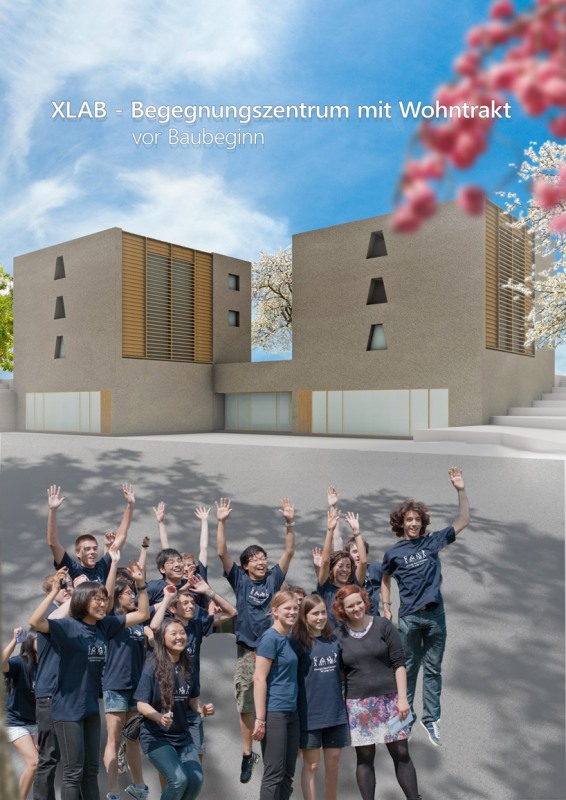
Visualisierung
Mit dem Bau des XLAB Begegnungszentrums mit Wohntrakt wird ein lange gehegter Wunsch realisiert. Schon 2006 war ersichtlich, dass das Laborgebäude des XLABs die Kapazitätsgrenzen erreicht hat. Nicht nur Labor- und Seminarräume waren ausgelastet, denn aufgrund des großen Wirkungsradius des Experimentallabors wurde deutlich, dass dringend eigene Unterbringungsmöglichkeiten für die Kursteilnehmer erforderlich waren. Die jungen Menschen kamen und kommen auch nach der Pandemie wieder aus ganz Deutschland, europäischen Nachbarländern und von allen Kontinenten.
Diese Internationalität spiegelt die Realität in der Forschung weltweit und die Sprache der Wissenschaft ist Englisch. Die Kommunikation zwischen den künftigen Nachwuchsforschern und erfahrenen Wissenschaftlern ist von großer Bedeutung für Studium und die Orientierung in den Fachdisziplinen. Einen Ort für den interdisziplinären und interkulturellen Austausch zu schaffen war ein lang angestrebtes Ziel. Dazu gehören geeignete Übernachtungsmöglichkeiten und Räume für Diskussion, Workshops und Präsentationen. Im Jahre 2012 ist es der XLAB Stiftung gelungen ein großes parkähnliches Gelände wenige 100 Meter entfernt vom Experimentallabor zu erwerben.
Für die Realisierung eines Begegnungszentrums mit Wohntrakt in Campusnähe hätte der Platz nicht günstiger sein können. Öffentliche Mittel vom Niedersächsischen Ministerium für Wissenschaft und Kultur und vom Bundesministerium für Bildung und Forschung konnten erfolgreich beantragt werden. Die XLAB Stiftung hat beachtliche Summen von privaten Förderern einwerben können und ist dafür außerordentlich dankbar. Sorge bereitet natürlich die im Moment nicht kalkulierbare Entwicklung der Bauwirtschaft. Voller Erwartung werden wir im März 2023 mit dem ersten Spatenstich das Bauvorhaben beginnen.
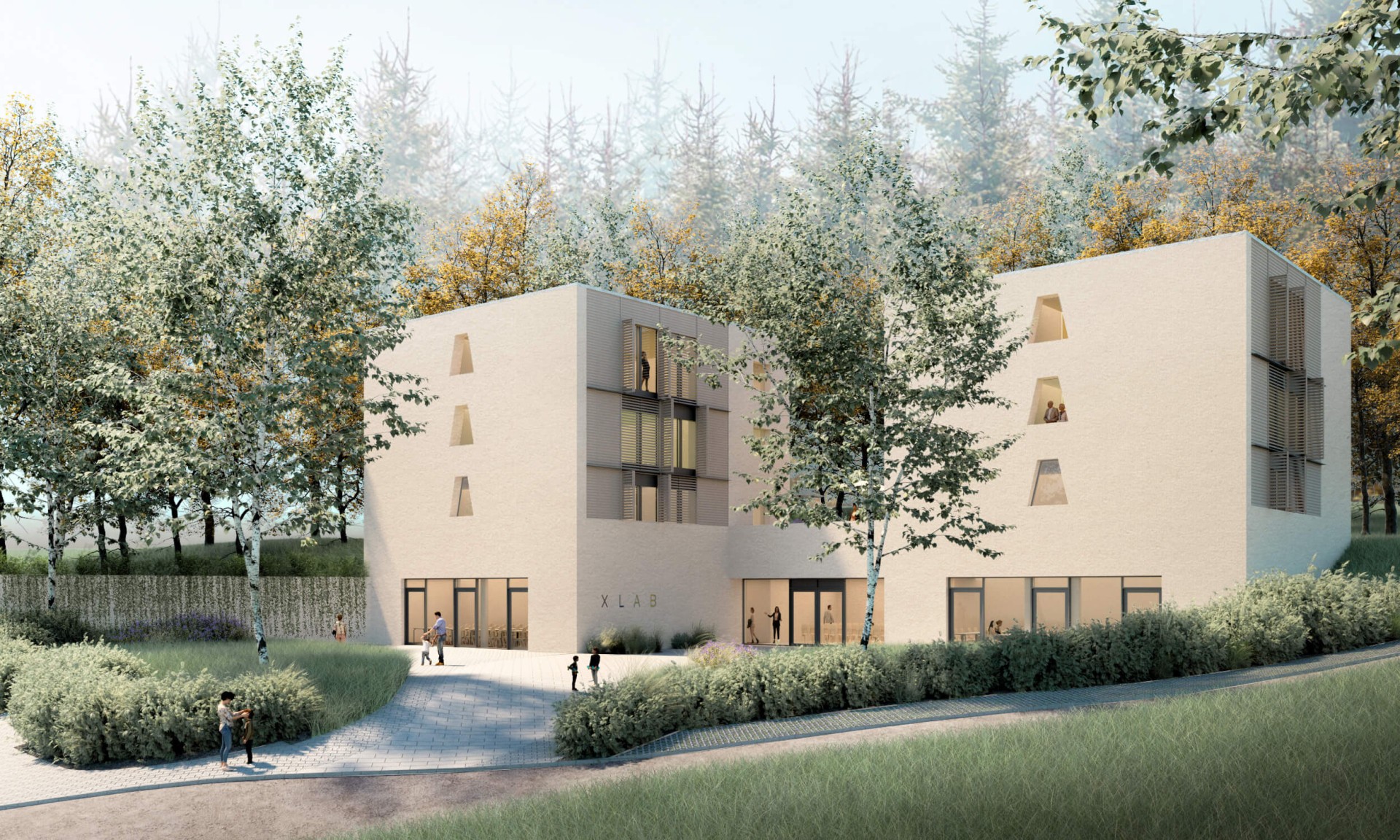
Visualisierung XLAB Begegnungszentrum (Areal des Neubaus)
12. November 2022
Imagebroschüre
Wir freuen uns, Ihnen die Imagebroschüre des zukünftigen Neubaus des Begegnungszentrums der Stiftung XLAB präsentieren zu können. Dieses Projekt stellt einen Meilenstein in der Geschichte unserer Stiftung dar und wir sind stolz, Ihnen einen ersten Einblick in die Gestaltung und Funktionsweise des neuen Gebäudes geben zu können. Diese Broschüre gibt Ihnen einen Überblick über die Architektur, die technische Ausstattung und die geplante Nutzung des Gebäudes. Sie wird Ihnen auch einen Eindruck davon vermitteln, wie das neue Zentrum die Region bereichern und die Förderung von Bildung und Innovation unterstützen wird. Wir sind überzeugt, dass dieses neue Gebäude eine wichtige Rolle in der Entwicklung der Region spielen wird und freuen uns darauf, die Eröffnung in naher Zukunft mit Ihnen zu feiern. Lassen Sie sich von der Imagebroschüre inspirieren und erfahren Sie mehr über das Begegnungszentrum der XLAB Stiftung.
 English
  German